
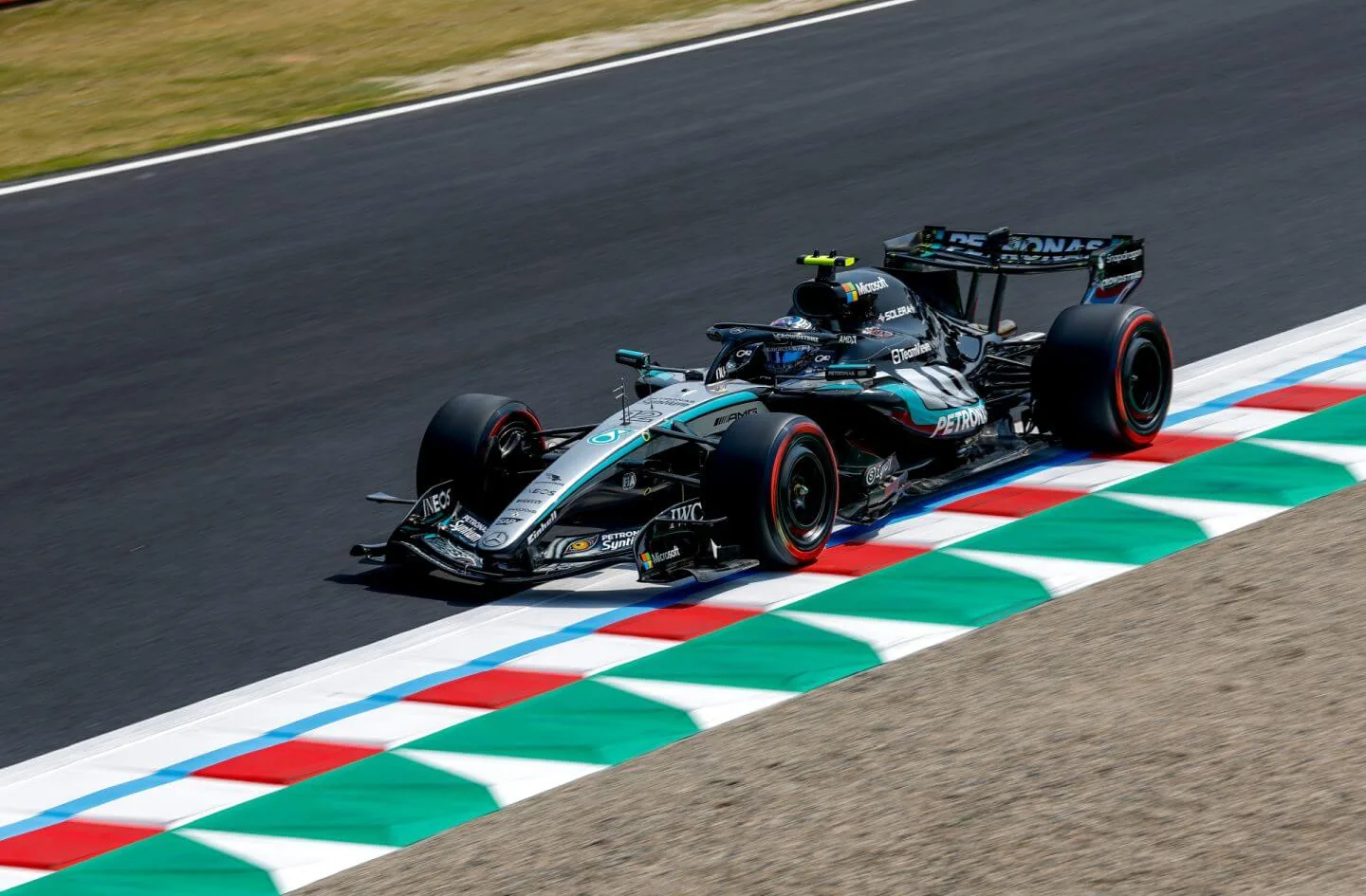
Kimi Antonelli secured Pole Position for the second time this year and led Mercedes to another front-row lockout in F1 qualifying. Behind them, McLaren and Ferrari drivers fought for the title of the second force. I invite you to the qualifying analysis before the 2026 Japanese GP.

Read more A handful of F1 Circus statistics after the 2026 Chinese GP
Qualifying at the Suzuka circuit was held in almost ideal weather conditions; it was sunny, and the track temperature slightly exceeded 30 degrees Celsius. The competition was extremely smooth, with everyone driving without breakdowns, errors, or blocking.
Qualifying results for the 2026 Japanese GP
| Pos. | Team | Q1 | Q2 | Q3 | |
| 1. | Kimi Antonelli | Mercedes | 1:30.035 | 1:29.048 | 1:28.778 |
| 2. | George Russell | Mercedes | 1:29.967 | 1:29.686 | 1:29.076 |
| 3. | Oscar Piastri | McLaren | 1:30.200 | 1:29.451 | 1:29.132 |
| 4. | Charles Leclerc | Ferrari | 1:29.915 | 1:29.303 | 1:29.405 |
| 5. | Lando Norris | McLaren | 1:30.401 | 1:29.795 | 1:29.409 |
| 6. | Lewis Hamilton | Ferrari | 1:30.309 | 1:29.589 | 1:29.567 |
| 7. | Pierre Gasly | Alpine | 1:30.584 | 1:29.874 | 1:29.691 |
| 8. | Isack Hadjar | Red Bull | 1:30.662 | 1:30.104 | 1:29.978 |
| 9. | Gabriel Bortoleto | Audi | 1:30.359 | 1:29.990 | 1:30.274 |
| 10. | Arvid Lindblad | Racing Bulls | 1:30.781 | 1:30.109 | 1:30.319 |
| 11. | Max Verstappen | Red Bull | 1:30.519 | 1:30.262 | |
| 12. | Esteban Ocon | Haas | 1:30.915 | 1:30.309 | |
| 13. | Nico Hulkenberg | Audi | 1:30.358 | 1:30.387 | |
| 14. | Liam Lawson | Racing Bulls | 1:30.657 | 1:30.495 | |
| 15. | Franco Colapinto | Alpine | 1:30.931 | 1:30.627 | |
| 16. | Carlos Sainz | Williams | 1:30.927 | 1:31.033 | |
| 17. | Alexander Albon | Williams | 1:31.088 | ||
| 18. | Oliver Bearman | Haas | 1:31.090 | ||
| 19. | Sergio Perez | Cadillac | 1:32.206 | ||
| 20. | Valtteri Bottas | Cadillac | 1:32.330 | ||
| 21. | Fernando Alonso | Aston Martin | 1:32.646 | ||
| 22. | Lance Stroll | Aston Martin | 1:32.920 |
The fight for Pole Position and race forecast for the frontrunners
Usually, the advantage of the best cars at Suzuka is greater than on typical tracks. If a team dominates in a given season, it is very clearly visible at Suzuka. Therefore, the front-row lockout for Mercedes drivers in qualifying was no surprise. I was surprised, however, by their advantage, as I expected more than 0.35 seconds over the third driver, but more on that later. Antonelli comfortably won qualifying; the Italian drove very well in every segment of the session and also held overall records in the second and third sectors. Both of his laps in Q3 secured him Pole Position. George Russell was second, slower than his teammate throughout the session. The reason is said to be missed car settings; he had to adjust his driving style during the session. They made a mistake in the settings between practice and qualifying. He will have to race with these settings, so Antonelli seems to be the favorite for the win.
The second force in qualifying was McLaren, or rather Oscar Piastri, who performed very well. Lando Norris had technical problems with the car (mainly the engine) in each of the practice sessions; the whole weekend is not successful for him because of this, and he entered qualifying much less prepared. Various analyses show that compared to the start of the season in Australia, McLaren has clearly improved the utilization of the Mercedes power unit; in this field, they are already very close to the factory team in qualifying. McLaren loses to the leader because of its car, which is not sufficiently developed and is overweight. In the race, McLaren’s form may be worse because of this; in practice, they showed higher tire degradation than the other two top teams. However, it can be seen that thanks to the optimization of the available package alone, they improved significantly in March.
Ferrari performed weaker in Japan than before, and in my opinion, the engine is to blame here. Suzuka is a track where the difference in engine power is more severe; besides, it is harder to recover energy here (the limit for qualifying was reduced, which helped weaker engines). The pace of the Ferrari drivers in the first sector, where high-speed corners are most important, was very good (Leclerc and Hamilton had the best results), but they lost in the other two. In the third sector, where there is only one chicane and two straights, they were in the second half of the field. In my opinion, Ferrari has made a really good car, but the power unit is holding them back. The exception is race starts, as they are the best there. Leclerc made a mistake in the Spoon corner on his final lap, which could have cost him up to 0.3 seconds. So he had a chance to finish qualifying very close to Russell and Piastri. Both Ferrari drivers lost on the straights due to power delivery issues.
The three top teams have an advantage over their rivals. The race should be a one-stop strategy unless neutralizations occur at convenient moments. Mercedes will be the favorite for a 1-2 finish; their race pace is the best. Based on practice, Ferrari should be the second force and McLaren the third. Ferrari should gain a lot at the start; on this track, this is facilitated by the layout of the first corner. Ultimately, in pure pace, Mercedes will be too strong. I am curious if McLaren will be able to compete at Ferrari’s level or perhaps even beat them.
Overview of other drivers and teams
The midfield has become extremely close, a lot is happening there, and drivers from four teams advanced to Q3. The best of this group was Pierre Gasly, who impressed again and showed that there is significant potential in the Alpine car. It’s a pity that Franco Colapinto did not utilize it and lost a lot. Audi’s form looks equally impressive. There were moments when this team looked like the fourth force. Ultimately, Gabriel Bortoleto was ninth and Nico Hulkenberg 13th, so it’s a typical midfield position but with the potential to fight for points with both cars. Arvid Lindblad also deserves praise, as he advanced to Q3 at the last moment. The Racing Bulls team is only slightly worse than Red Bull.
The aforementioned Red Bull has a major problem. They introduced a large aerodynamic update package this weekend, and Max Verstappen was eliminated in Q2, complaining regularly about the car’s handling. Hadjar reportedly does not have the updates on his car (I’m not 100% sure here), but he advanced to Q3. Again, problems with development during the season are appearing, and additionally, the gaps to the front are very large. Red Bull is currently not thinking about chasing the top three, but defending against midfield rivals. Red Bull’s problem is the car. Their power unit is not as efficient as Mercedes, but its performance is competitive. The vast majority of the losses are related to the car, with overweight playing a significant role.
A negative surprise of qualifying was the elimination of Oliver Bearman already in Q1. However, the Haas driver had some minor problems with the car.