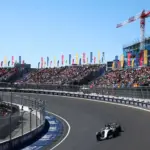
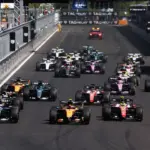
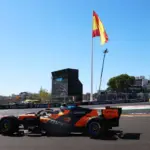

History and characteristics of the Circuito de Madring track in Spain. Technical data and layout of the Madring track in Madrid. Formula 1 races for the Spanish GP at the Circuito de Madring track. Fastest laps of the Madring track in Spain.
Read more Tymek Kucharczyk third in the Indy NXT series in the 2026 season
History and basic information about the Circuito de Madring track in Spain
Located near Madrid, the Jarama track hosted the Spanish GP races from 1968 to 1981. For more than four decades, F1 races were held in other locations in the country, but the capital city did not say its last word, with regular rumors about a possible return. Several years ago, Bernie Ecclestone received a proposal from private investors to organize a street race in Madrid. It did not come to fruition at that time but was used as an argument in negotiations for another contract with the Circuit de Barcelona-Catalunya track. In 2022, a completely different idea emerged, which was realized.
Due to the growing interest in F1 worldwide, as well as the organization of an F1 exhibition that proved extremely popular, the IFEMA trade center in Madrid decided to organize a Formula 1 race. Initial talks between Liberty Media and Madrid began in 2022, and details became known in the first half of 2023. After more than a year of negotiations, a ten-year contract was signed with Liberty Media at the beginning of 2024. The rights to name the races as the Spanish Grand Prix were also negotiated, effectively pushing the competing Barcelona-Catalunya track out of the calendar (it remains in a rotational agreement with Belgium). Construction of the Madring track (a name combining Madrid and ring) began in April 2025 and was completed a few weeks before the inaugural F1 race in September 2026. The surrounding infrastructure was not fully ready, so the complex will be fully operational in 2027. Contracts with construction companies for the track itself amounted to 83 million euros. All investments were much larger because the entire surrounding commercial infrastructure had to be built.
The track was built in the northeastern part of Madrid near the IFEMA trade center and the Valdebebas district. A section borders the Real Madrid training center. This is a new area of Madrid, so there are no views of historic buildings. The area around the planned Madring track in Madrid is very well connected; most fans (estimated up to 90%) are expected to arrive by public transport. This was an important argument for Liberty Media. Existing buildings of the trade center will be used as the track’s facilities.
Circuito de Madring is not a typical street circuit; it should be classified as a semi-street facility. The track layout partially runs on previously existing public streets (about 1.3 km), and the rest (4.1 km) was built from scratch or heavily modified. The specially built sections will not be used for normal street traffic. Madring will have one main configuration. It may potentially be used more often than just during F1 events; we will see if they try to include other racing series in the calendar.
Layout of the Circuito de Madring track in Spain
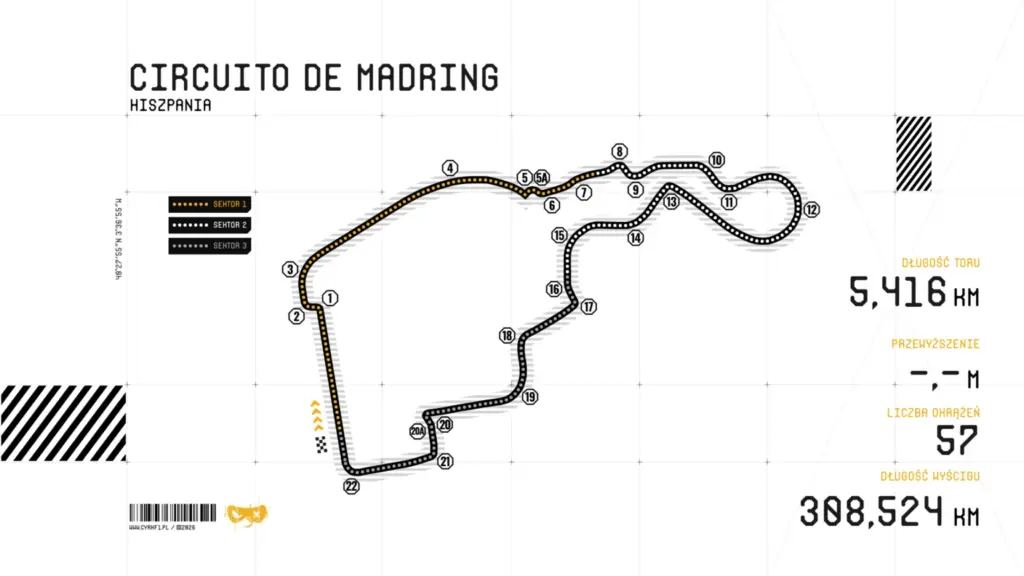
Characteristics of the Madring track in Madrid
The designer of the Madring track is Jarno Zaffelli and his office Dromo Design. They prepared a truly extreme track layout that will be very demanding for drivers. The track features various types of corners, requiring the driver to maintain full concentration at all times, with no room for error. Even the longest section driven at full throttle between corners 2 and 5 is not a typical straight, so constant vigilance is necessary. Additionally, the track has significant elevation changes, including uphill and downhill sections, as well as a very demanding banked corner reminiscent of oval tracks. In theory, this promises a very good track for qualifying; it will be difficult to drive the entire lap at the limit. Races may be less exciting because there is only one good overtaking spot at corner number 5. The start/finish straight is very short, as is the approach to the first corner after the start. There is still a chance for overtaking maneuvers in the banked corner when there is a larger pace difference between drivers.
A famous spot on this facility will be the banked corner number 12 called “La Monumental.” The corner is 550 meters long, with a maximum banking of 24% at its steepest point (for comparison, the Zandvoort track had a maximum banking of 19% at one point). The corner should allow for different racing lines, will be taken at full speed, and will be tightly surrounded by concrete barriers. Around this corner, grandstands with 45,000 seats will be built, creating a unique place in the entire Formula 1 calendar.
The track will be very demanding for cars. There are many difficult corners, and drivers will have to drive extensively on curbs. Cooling will be a challenge due to the twisty layout surrounded by barriers. There may be more mechanical failures than usual, and brakes will be heavily stressed. However, it is a very good track for current power units; electrical energy should never run out, and battery charging will be natural during numerous braking zones and corners where full throttle is not applied.
Pirelli will bring three middle tire compounds to the Madring track in 2026. The tire manufacturer conducted preparatory work for the first F1 visit to this track for three years. According to simulations, Madring will be one of the most tire-demanding tracks on the calendar. A particular challenge will be the banked La Monumental corner, where tires will experience high forces for several seconds. The laid asphalt is very smooth, so surface evolution during the weekend will be significant (as for street circuits). Before the first F1 visit, the asphalt was cleaned with high-pressure water, improving its grip. For drivers, maintaining tires at the proper temperature throughout the qualifying lap will be challenging due to the numerous demanding corners. It is difficult to predict strategy before the first practice sessions.
Races at the Madring track are held in the first half of September. Summer ends in Madrid at that time, but it is still very warm. During Formula 1 visits, air temperatures of 25-30 degrees Celsius should be expected. The chances of rain are very low. Due to the track’s characteristics, which is tightly surrounded by barriers, one should expect safety car deployments to occur regularly.
Technical data of the Circuito de Madring track in Spain
Track length: 5.416 km
Number of F1 race laps: 57
F1 race distance: 308.524 km
Number of corners: 22 (including 10 left and 12 right)
Direction of travel: clockwise
Elevation change: no data
Longest straight: just under 1.0 km
Grandstand capacity: 120,000 seats*
Maximum G-force in F1: no data
Length of pit lane with speed limit: no data
Number of DRS zones: two, between corners 3 and 4, and between corners 22 and 1.
Read more A handful of F1 Circus statistics after the 2026 Italian GP
Overtaking mode: detection point before corner number 2, activation point after the start/finish straight begins
Distance from the first grid position to the first corner after the start: no data
Grip limited on: rear axle “rear limited”
Percentage of races with safety car deployment: will be known after the first race
* Initially, the track capacity will be 120,000 fans but can be increased to 140,000 in the future
Fastest laps on the Madring track in Spain
The Madring track debuted in Formula 1 in the 2026 season, and from that moment, record lap times count.
Best qualifying time – 1:XX,XXX – Driver – Team – 2026
Best race time (official track record) – 1:XX,XXX – Driver – Team – 2026
Information about the Madring track from Pirelli
Pirelli rates the characteristics of each track in the Formula 1 calendar on a scale from 1 to 5, where 1 means the least and 5 the most. These numbers are determined over the entire season, so for example, the Monza track gets a 1 for aerodynamic downforce level, while the Hungaroring gets a 5.
Traction: 3
Braking: 3
Lateral G-forces: 4
Tire wear: 3
Aerodynamic downforce level: 4
Formula 1 races at Circuito de Madring in Spain
The Madring track is the seventh facility in Spain to host a Formula 1 race and the sixth host of the Spanish GP. The exception was the street circuit in Valencia, which hosted the European GP five times. Spanish GP races have been present in the Formula 1 calendar almost from the beginning, since 1951, but have been held regularly only since the late 1960s. The owners of the Madring track signed a ten-year contract with Liberty Media in January 2024 to organize F1 races from 2026 to 2035. They are to pay an annual licensing fee of 48 million euros – the highest among European tracks. It is a private venture but supported by the local government. Madring took over the organization of the Spanish GP from the Circuit de Barcelona-Catalunya by presenting Liberty Media with a much better financial offer.
Characteristics, technical data, and layouts of other tracks from the Formula 1 calendar can be found at this link in a special category of articles on the Cyrk F1 blog. The current length of contracts for organizing F1 races can be checked here, where a complete table is available.
Read more Impressive victory of Kimi Antonelli in the 2026 Italian GP