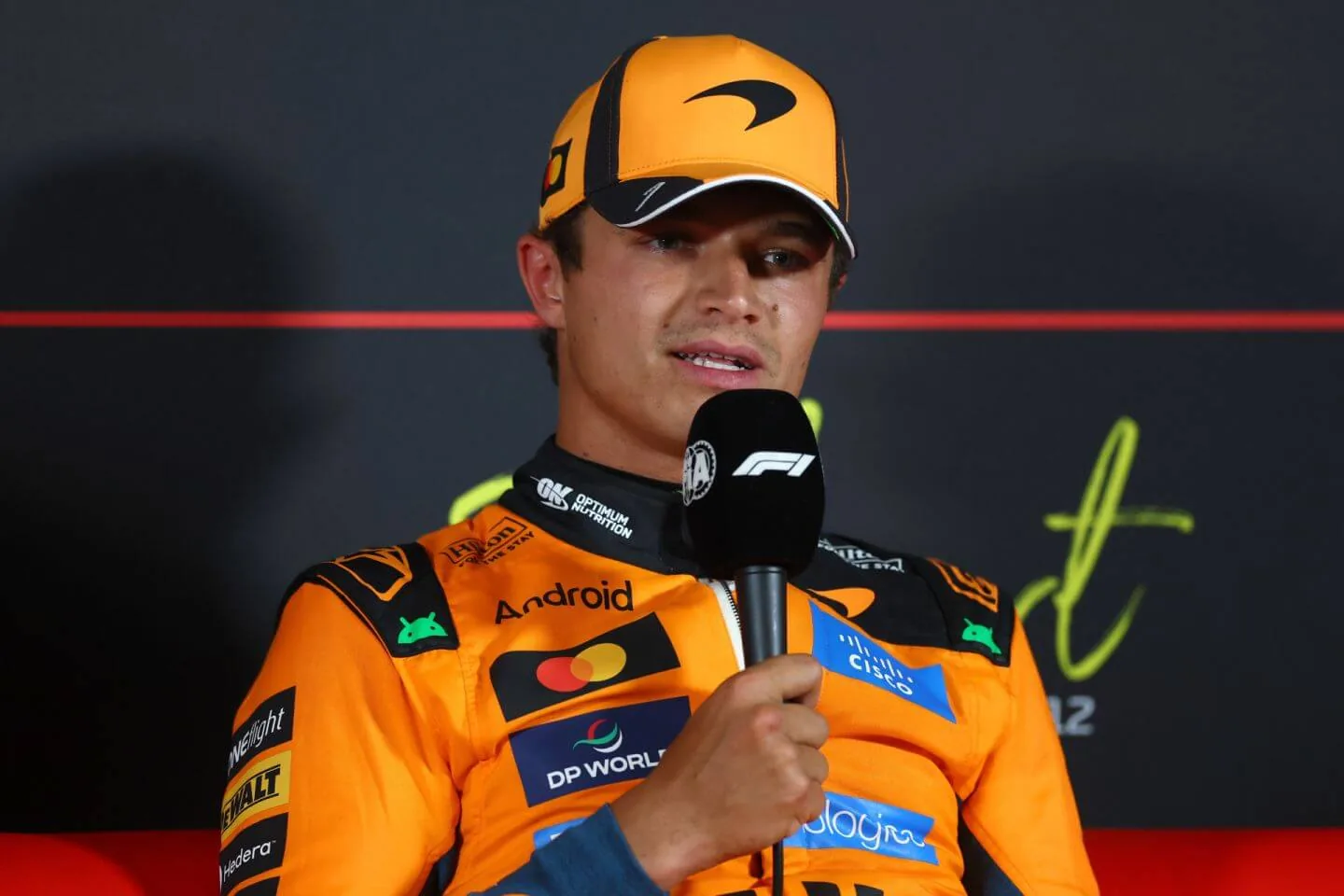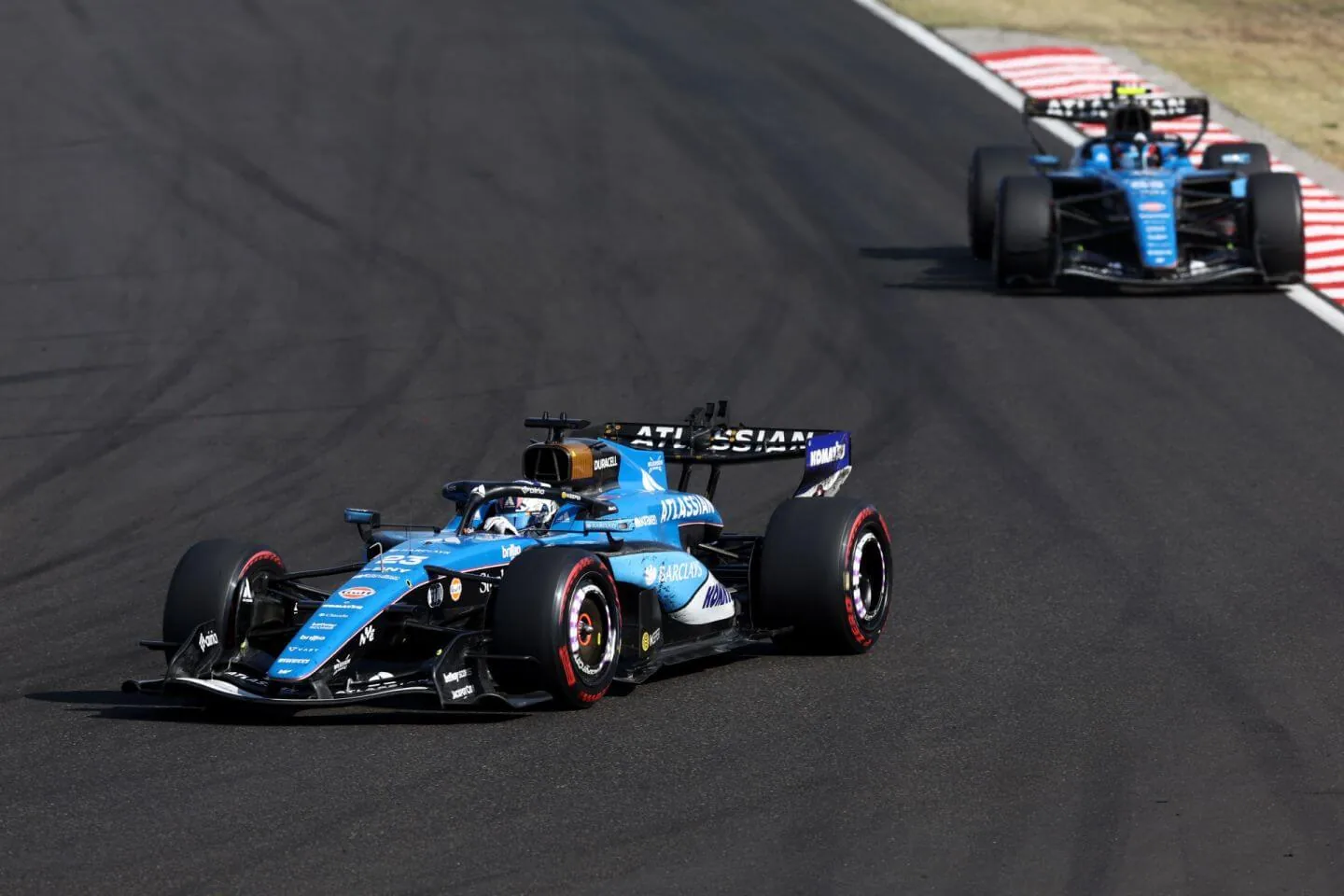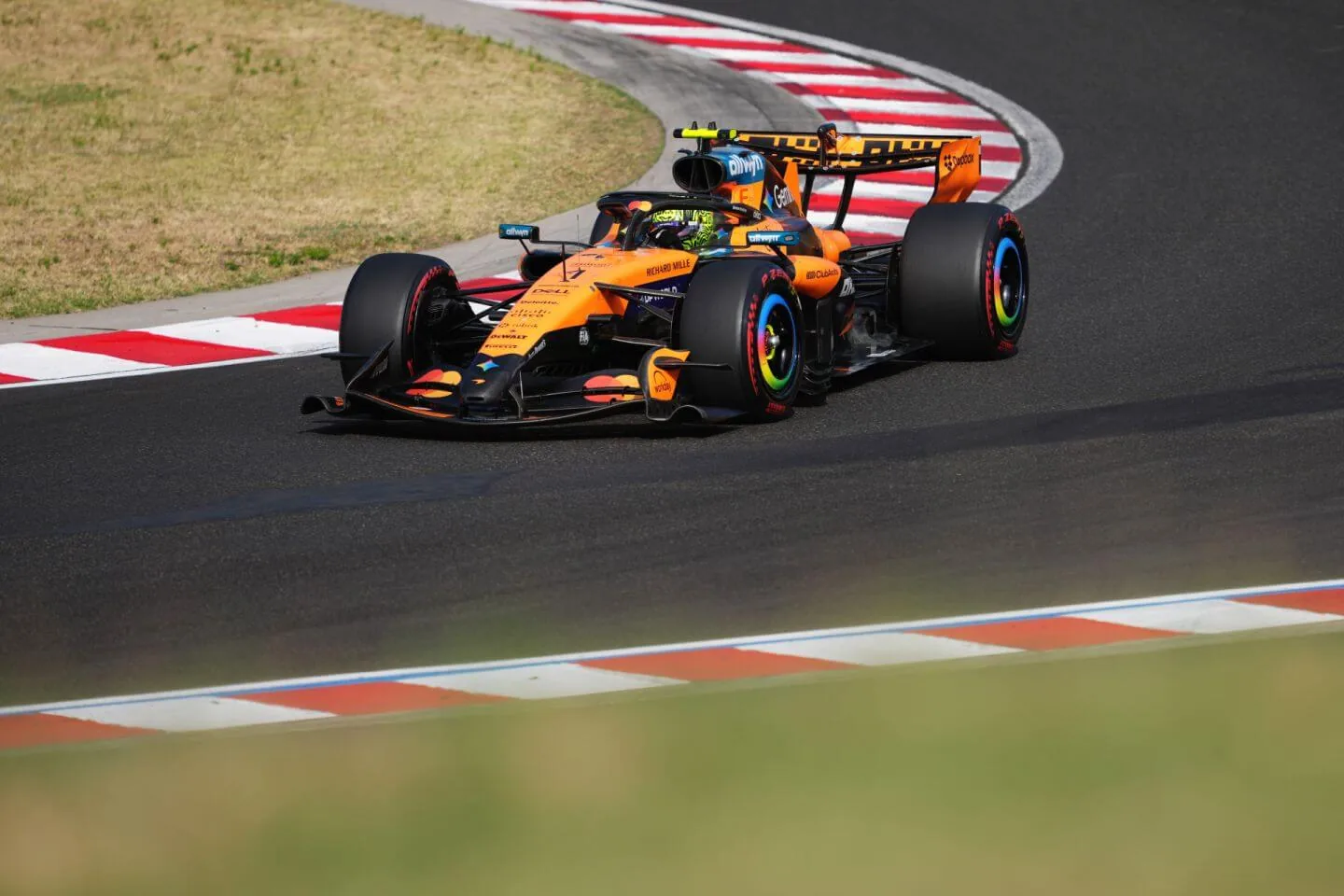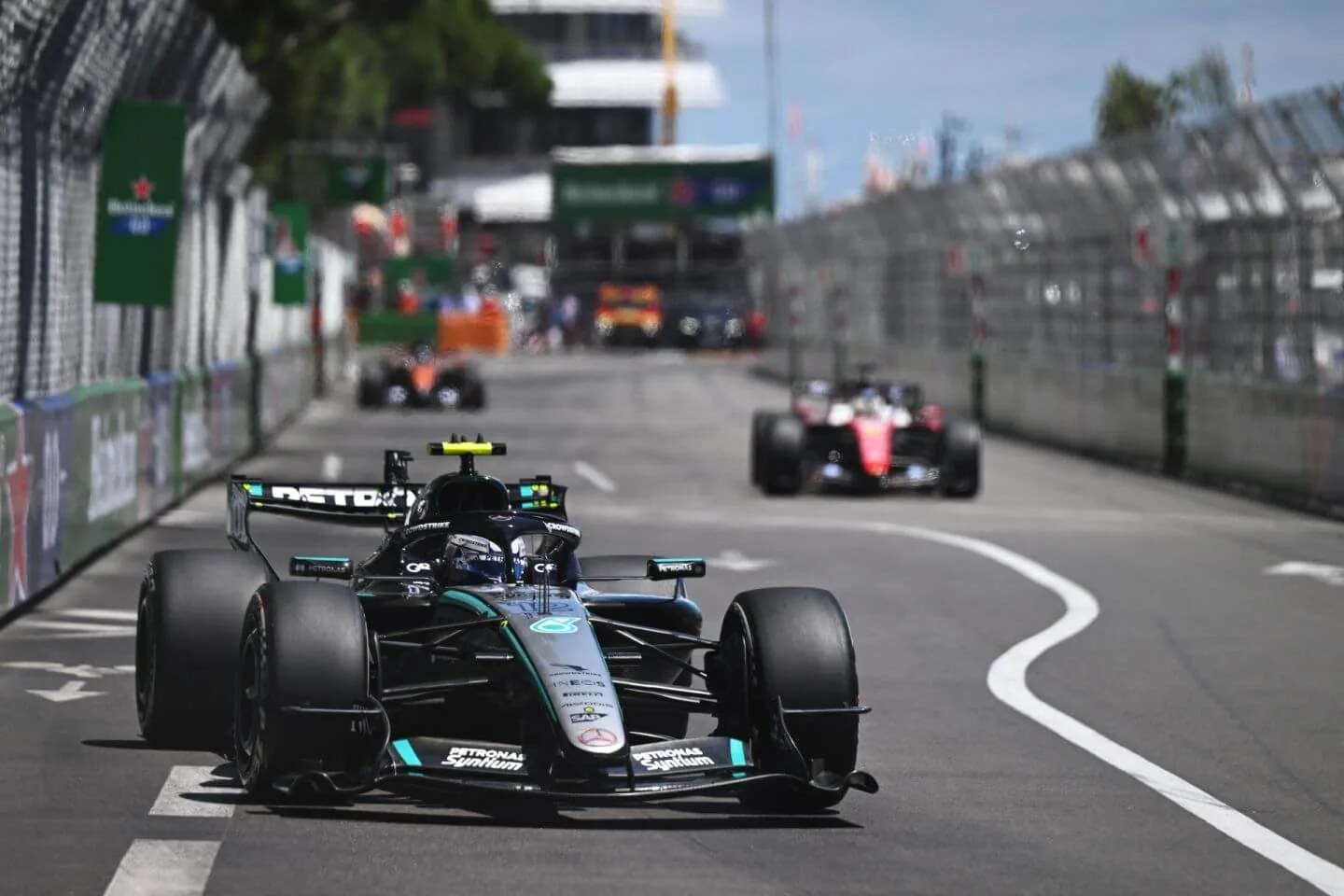

Lando Norris very confidently won the 2026 Hungarian GP race. It was the first victory for a McLaren driver this season, and the team’s drivers were the fastest at Hungaroring. Piastri, however, retired due to a failure, so the podium was completed by Verstappen and Antonelli, who drove almost flawless races.
Read more Bahrain GP at the Sepang circuit in Malaysia will complete the F1 calendar in 2026
The 2026 Hungarian GP race was held in high air temperatures, exceeding 30 degrees Celsius. At the start of the race, the asphalt temperature was 53 degrees, and by the end, it dropped slightly below 50 degrees. It was the warmest day of the weekend, which influenced the teams’ approach to strategy. Traditionally, there was no full safety car period at Hungaroring, but we had a short virtual safety car at the end of the race when Piastri’s broken car needed to be cleared.
2026 Hungarian GP Race Results
| Pos. | Driver | Team | Time | Points |
| 1. | Lando Norris | McLaren | 1:39:56.180 | 25 |
| 2. | Max Verstappen | Red Bull | +15.080s | 18 |
| 3. | Kimi Antonelli | Mercedes | +18.728s | 15 |
| 4. | Charles Leclerc | Ferrari | +23.840s | 12 |
| 5. | Lewis Hamilton | Ferrari | +24.540s | 10 |
| 6. | Isack Hadjar | Red Bull | +55.488s | 8 |
| 7. | George Russell | Mercedes | +57.503s | 6 |
| 8. | Liam Lawson | Racing Bulls | +1 lap | 4 |
| 9. | Nico Hulkenberg | Audi | +1 lap | 2 |
| 10. | Arvid Lindblad | Racing Bulls | +1 lap | 1 |
| 11. | Gabriel Bortoleto | Audi | +1 lap | 0 |
| 12. | Pierre Gasly | Alpine | +1 lap | 0 |
| 13. | Lance Stroll | Aston Martin | +1 lap | 0 |
| 14. | Fernando Alonso | Aston Martin | +1 lap | 0 |
| 15. | Franco Colapinto | Alpine | +2 laps | 0 |
| 16. | Esteban Ocon | Haas | +2 laps | 0 |
| 17. | Alexander Albon | Williams | +2 laps | 0 |
| 18. | Carlos Sainz | Williams | +2 laps | 0 |
| 19. | Oliver Bearman | Haas | +2 laps | 0 |
| NC | Oscar Piastri | McLaren | DNF | 0 |
| NC | Sergio Perez | Cadillac | DNF | 0 |
| NC | Valtteri Bottas | Cadillac | DNF | 0 |
This time, the race description is in a slightly different format, from the perspective of the top four teams and grouped for the rest of the field.
McLaren was the strongest in this race
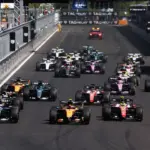
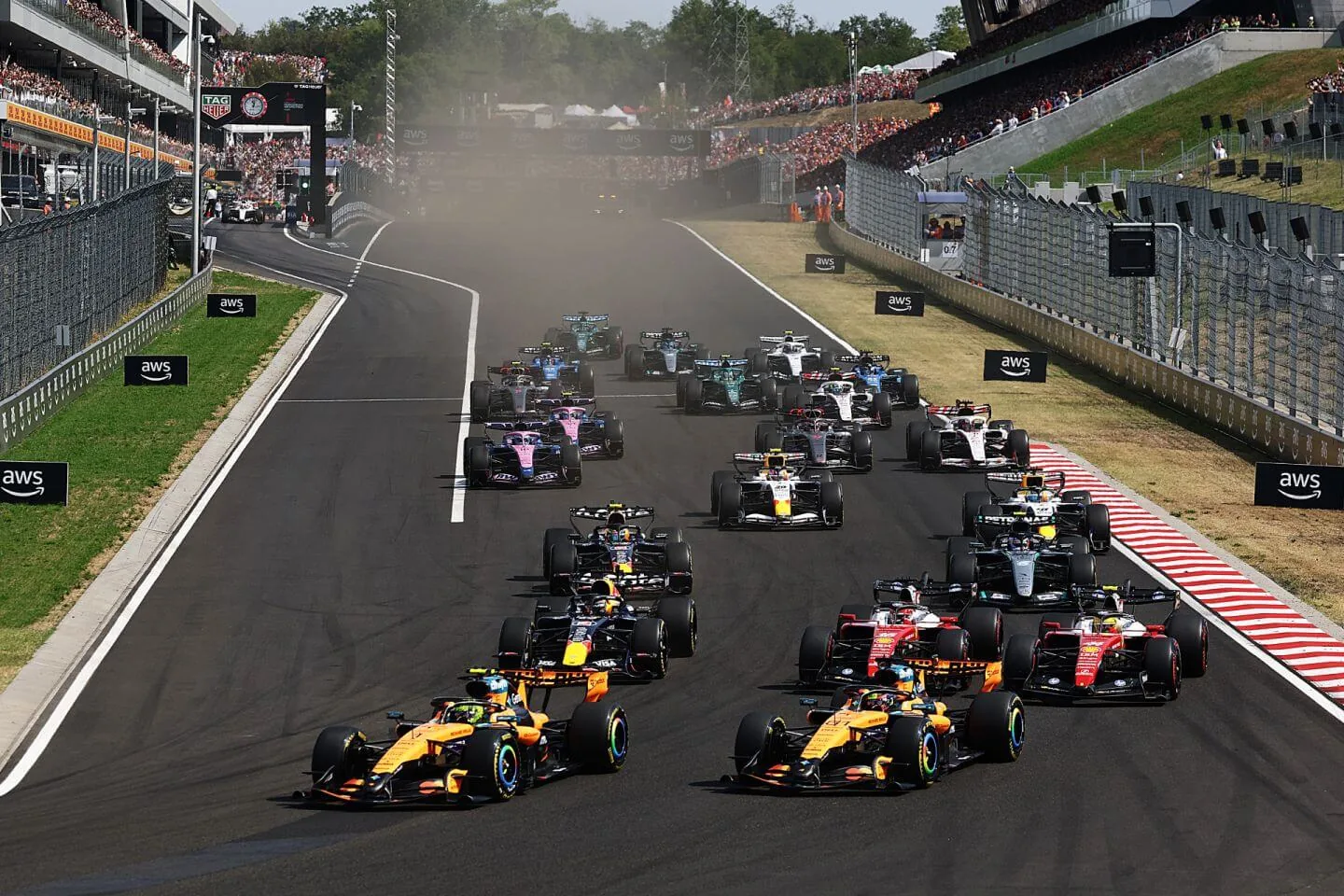
McLaren drivers were the best in this race. Norris’s race pace was excellent, by far the best in the field. Piastri was a bit behind him but should have comfortably secured second place if not for the failure. At the start, Piastri performed brilliantly, moving into the lead from third on the grid. Norris had a slight slide in the second corner and was overtaken then. The McLaren drivers led and gradually extended their advantage. Norris stayed close to Piastri throughout. They were forced to make their first pit stops earlier than planned due to aggressive strategies from their rivals at the front, but they managed to maintain their track positions. The time advantage diminished, but over the distance, they again built up a few seconds’ lead. The second pit stops were crucial, as Piastri pitted quite quickly, reacting to a potential undercut from Hamilton, while Norris stayed out for six more laps. In clear air, Norris set truly excellent lap times, and Piastri additionally lost about two seconds while lapping Carlos Sainz, who not only didn’t yield quickly but also had a minor collision. After the second pit stops, Norris took the lead and drove the fastest. Piastri was heading for second position, but at some point, his gearbox broke, and he retired from the race. Norris won confidently, made an additional pit stop during the VSC for safety, and drove cautiously at the end, avoiding curbs, yet still had a 15-second lead.
McLaren achieved excellent results in Hungary for the fourth consecutive year. This weekend, they introduced important changes to the car, mainly concerning the floor, which brought noticeable benefits. Their car this year performs better on such twisty tracks due to shorter gearbox ratios, but the scale of their advantage in pure race pace was surprisingly large for me. They are expected to have the second part of their upgrade package after the summer break in the Netherlands. One can be quite optimistic for the rest of the season, especially on similar, more twisty tracks.
Maximizing potential from Red Bull
Looking at the raw lap times, in my opinion, Red Bull was the fourth force in this race, yet Max Verstappen secured second place, and Isack Hadjar sixth. How is this possible? Both drivers utilized their capabilities 100% and had ideal strategies. Verstappen was particularly impressive. At the start, the Dutchman moved up to third place and continuously held back a potentially faster Hamilton, who had better tires. When the Briton made an earlier pit stop and thus overtook the Dutchman, Verstappen seized the moment when Hamilton was overtaking Lawson on the main straight, braked very late, and passed both in the first corner. This might be the best overtaking maneuver of the season. He was again ahead of Hamilton and could once again drive at his own pace, maintaining track position. Red Bull gave him a well-chosen strategy, as they delayed his second pit stop and put used soft tires on Verstappen’s car. Towards the end, he had good pace on them, and when rivals changed tires during the VSC, he gained track position and finished in second place. Isack Hadjar fought much further back, didn’t have quite as good pace, but finished in sixth position, which must be considered a good result.
Verstappen repeatedly complained about the car this weekend; Red Bull wasn’t as good as the rest of the front-runners, but everything worked in their favor. First, penalties for two drivers after qualifying and Verstappen’s advancement on the grid. In the race, excellent driving with an ideal strategy and further mistakes problems from rivals – everything went their way. The increase in form compared to the start of the season has been clear since the introduction of a major upgrade package in Austria. After the summer break, in my opinion, they will contend for wins on certain tracks that suit their car better.
Very mixed feelings at Mercedes
Mercedes was beaten to such a great extent for the first time this year; they had no chance of winning at all. George Russell completely messed up the start, dropping to the very back of the field. There must have been some power unit issue there, not a driver error. After completing the first corner, the race for Russell was practically over. He skillfully cut through the drivers from the second half of the field, but along the way, he incurred such significant time losses that he could only hope for eighth place (seventh due to Piastri’s failure). Additionally, at the very end of the race, he made his second pit stop one lap before the virtual safety car appeared, which was an unlucky situation, as he thus lost a position to Hadjar.
Kimi Antonelli maximized his potential, driving on a slightly different strategy than the rest of the front-runners, as he made his pit stops later. This strategy, combined with very good pace in clear air and rivals’ problems, gave him third place. In my opinion, observing the lap times, Antonelli was slower only than the McLaren drivers. This confirms what we have observed this year, namely that Mercedes makes a difference in race pace on hard tires. Third place is a very good performance for Antonelli after starting from seventh on the grid.
Mercedes continues its very inconsistent season. Regularly, their drivers experience various types of problems (mainly technical), due to which they have lost a lot of points. Additionally, rivals have significantly improved their cars and are now at their level. Mercedes is expected to respond with an important upgrade package after the summer break, which is crucial for them. In the second half of the season, their drivers will even receive penalties twice for exceeding engine allocations, so they must clearly improve to avoid losing points on other weekends. At the moment, they still control the season, but the margin is small.
A weekend of missed opportunities for the Ferrari team
Ferrari previously seemed to be the favorite for this weekend, but due to minor driver errors and poor strategy, they didn’t even secure a podium. This entire weekend was a series of small, very costly mistakes. Hamilton received a penalty after qualifying for blocking Piastri, which he should have avoided. At the start of the race, Leclerc started from second place but immediately dropped to fifth behind Hamilton. Both Ferrari drivers started on soft tires, the only ones from the front, but gained nothing from it. In the first phase of the race, Hamilton got stuck behind Verstappen, unable to overtake him. Ferrari had planned for two pit stops from the outset; Hamilton quickly made his first, successfully undercutting Verstappen strategically, but a lap later, the Briton seemed to be caught off guard after overtaking Lawson, as the Dutchman successfully attacked him. Hamilton lost position, which was important for the rest of the race. He made his second pit stop very quickly; his strategy was risky, but it seemed it would secure him at least third place (he would have defended second position against Verstappen at the end). However, Ferrari decided to make pit stops during the VSC. Hamilton consequently dropped behind Antonelli – 0.1 seconds decided it there, and he also exceeded the pit lane speed limit by 0.1 km/h and received a 5-second penalty. Towards the end, he drove right behind Antonelli with better tires but couldn’t overtake and dropped behind Leclerc after the penalty was applied. The Monegasque driver drove slightly slower over the distance and had a somewhat more classic strategy but finished the race just behind Hamilton, whom he overtook after the penalty was added.
Read more Qualification analysis before the 2026 Hungarian GP
I am very disappointed with Ferrari, and this weekend also with Hamilton. There was potential for a double podium, but they left Hungary with nothing. On the other hand, if certain situations had played out slightly differently (e.g., Hamilton’s exit after a third pit stop), a podium was within reach. Ferrari tries to take risks with strategy, which worked in Barcelona, but not in other races. Overtaking is difficult at Hungaroring, so by opting for an aggressive strategy and quick pit stops, they force their drivers to overtake, which didn’t work against comparable rivals. They lose out on the straights due to the engine, and this neutralized any slight tire advantage.
Review of mid-field team results
To be completed soon.
Review of back-marker teams.
To be completed soon.
Current general classifications after the Hungarian GP can be found here. There have been several changes in both standings. We are after 11 of the 23 planned races.
Summary
The Hungarian GP was a very classic Formula 1 race. Little overtaking at the front, a lot of close driving behind rivals, relying on different strategies due to higher tire degradation. New cars and engines did not make overtaking easier at Hungaroring; it is still possible to block a slightly faster rival without major problems. Norris’s win and McLaren’s improved form are important in the context of the second half of the season. The competition at the front is becoming very close.
P.S. Formula 1 will return to competition in four weeks in the Netherlands, where there will be a sprint weekend. We expect an upgraded Honda engine there, as well as an important upgrade package for Mercedes. The second half of the season promises to be extremely intense, with 12 race weekends planned in 3.5 months.
P.S.2 During the summer break, many different articles should appear on the blog; I have many ideas saved, so I will try to publish something systematically.
Read more 5 unusual ways to survive the Formula 1 break without boredom