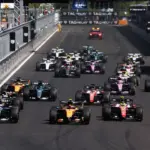

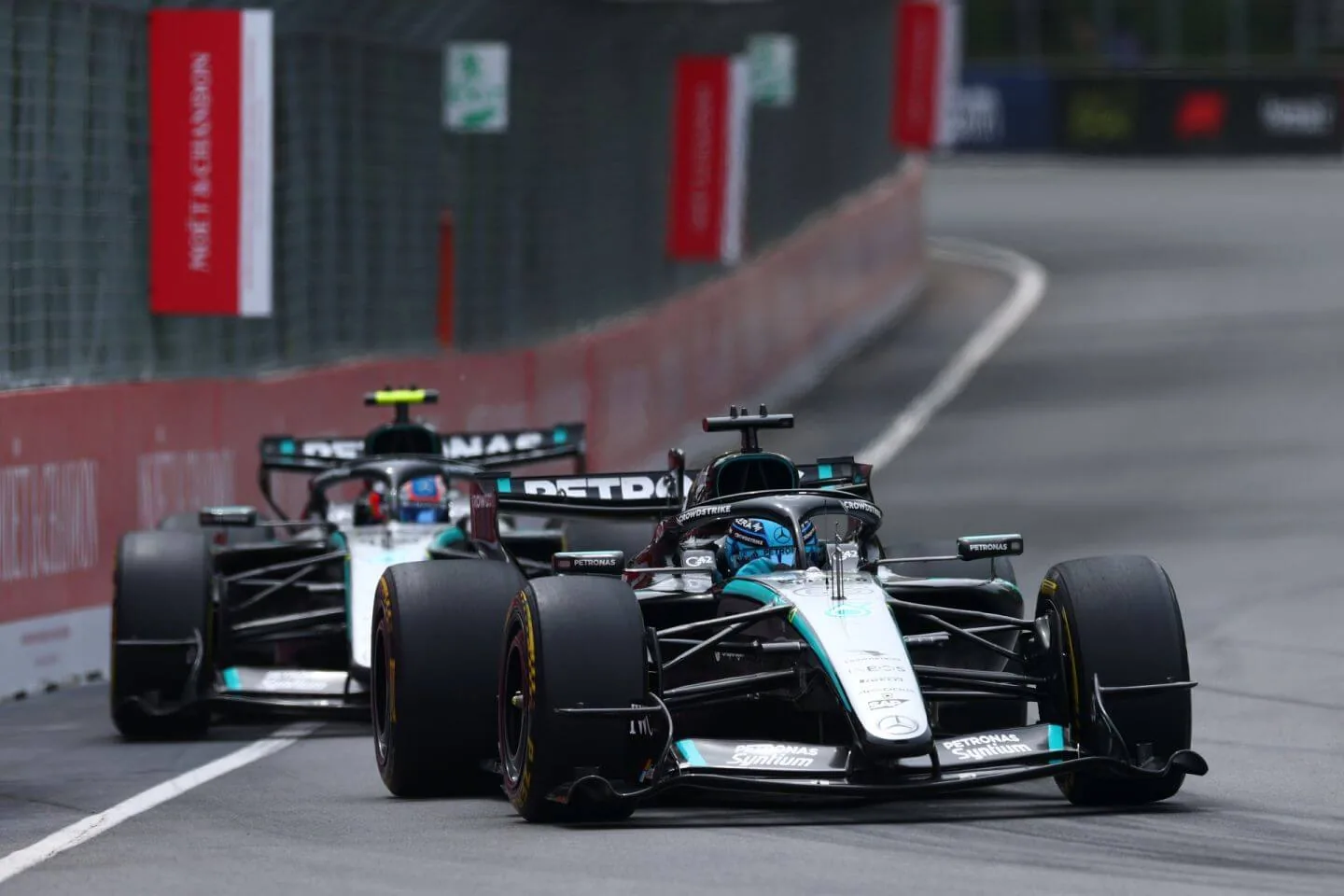
George Russell won the qualifying at the Montreal circuit for the third time in a row. The Briton, just like on Friday, defeated Kimi Antonelli, securing a Mercedes one-two finish. The qualifying was extremely close, with the top eight drivers within 0.4 seconds. Welcome to the qualifying analysis before the 2026 Canadian GP.
Read more Russell won the sprint before the 2026 Canadian GP
Qualifying at the Montreal circuit took place in stable weather conditions, with track temperatures of 30-31 degrees Celsius. This was 10 degrees cooler than during Friday’s sprint qualifying. The main qualifying was very calm, with no crashes or serious problems that would, for example, cause a yellow flag for an extended period.
2026 Canadian GP Qualifying Results
| Pos. | Team | Q1 | Q2 | Q3 | |
| 1 | George Russell | Mercedes | 1:13.953 | 1:13.079 | 1:12.578 |
| 2 | Kimi Antonelli | Mercedes | 1:13.380 | 1:13.076 | 1:12.646 |
| 3 | Lando Norris | McLaren | 1:13.503 | 1:13.049 | 1:12.729 |
| 4 | Oscar Piastri | McLaren | 1:13.559 | 1:13.285 | 1:12.781 |
| 5 | Lewis Hamilton | Ferrari | 1:13.767 | 1:13.041 | 1:12.868 |
| 6 | Max Verstappen | Red Bull | 1:14.067 | 1:13.479 | 1:12.907 |
| 7 | Isack Hadjar | Red Bull | 1:13.654 | 1:12.975 | 1:12.935 |
| 8 | Charles Leclerc | Ferrari | 1:13.825 | 1:13.496 | 1:12.976 |
| 9 | Arvid Lindblad | Racing Bulls | 1:13.895 | 1:13.548 | 1:13.280 |
| 10 | Franco Colapinto | Alpine | 1:14.466 | 1:13.857 | 1:13.697 |
| 11 | Nico Hulkenberg | Audi | 1:14.562 | 1:13.886 | |
| 12 | Liam Lawson | Racing Bulls | 1:14.346 | 1:13.897 | |
| 13 | Gabriel Bortoleto | Audi | 1:14.775 | 1:14.071 | |
| 14 | Pierre Gasly | Alpine | 1:14.698 | 1:14.187 | |
| 15 | Carlos Sainz | Williams | 1:14.276 | 1:14.273 | |
| 16 | Oliver Bearman | Haas | 1:14.449 | 1:14.416 | |
| 17 | Esteban Ocon | Haas | 1:14.845 | ||
| 18 | Alexander Albon | Williams | 1:14.851 | ||
| 19 | Fernando Alonso | Aston Martin | 1:15.196 | ||
| 20 | Sergio Perez | Cadillac | 1:15.429 | ||
| 21 | Lance Stroll | Aston Martin | 1:16.195 | ||
| 22 | Valtteri Bottas | Cadillac | 1:16.272 |
Battle for Pole Position and Race Forecast for the Front Runners
In the main qualifying, all the front runners improved their times compared to the sprint qualifying, gaining a few tenths of a second. At the same time, the power balance remained practically the same. The small time differences are particularly noteworthy. Eight drivers from four top teams were within just 0.398 seconds in Q3. Before the season, if someone had told me there would be such a close competition, I would never have believed it. The new regulations were supposed to increase the gaps in the field, but at the front they are very small.
Weather is an important factor. During the main qualifying, it was noticeably cooler than on Friday. Drivers often did an extra lap to properly warm up the tires. The weather forecast predicts even cooler conditions on Sunday, with light rain expected throughout the day. Teams certainly took this into account when setting up their cars. Mercedes did so and spoke openly about it after qualifying. These changes negatively affected their form in qualifying but are expected to pay off on Sunday.
Mercedes drivers did not look like favorites during this qualifying. Their form was quite variable, with minor mistakes appearing. Until the end of Q3, it seemed there was a chance they could be beaten or at least not achieve a one-two finish. Russell spoiled his first run in Q3, leaving only a chance at the very end. He drove an excellent lap that secured him Pole Position. The Briton won qualifying in Canada for the fourth consecutive time (counting Friday’s sprint qualifying). Antonelli looked more confident earlier but was unable to match Russell’s pace. As in Friday’s qualifying, the difference between them was 0.068 seconds. Antonelli had a chance for Pole Position this time but did not deliver his optimal lap. The Italian had the fastest first and third sector times, while Russell was fastest in the second.
McLaren was the second strongest team during qualifying. Analyzing the times closely, McLaren drivers competed only with Mercedes in the second and third sectors, but in the first, the most twisty sector, they were also beaten by Red Bull drivers and Hamilton. It seems McLaren slightly changed their setup after Friday to regain speed on the straights, which succeeded, but the deficit increased in the most twisty sector. The fact is McLaren is closest to Mercedes; in the sprint, Norris showed he can drive a competitive long-run pace. Norris and Piastri will be waiting on Sunday for any Mercedes driver problems to capitalize on.
Lewis Hamilton always feels good in Canada and confirmed this again this year. Fifth place was the maximum, considering the losses caused by a weaker engine compared to drivers using the Mercedes power unit. Hamilton spoiled his final lap by taking too much risk trying to improve his time. It is clear he can push and take risks in Canada. Leclerc, on the other hand, does not like this track and usually has poor results, so eighth place does not surprise me. His gap to Hamilton was small, so he should be satisfied. On Sunday, Ferrari drivers should hope for rain, as then engines play a smaller role, and Ferrari’s car has very good cornering speed and grip.
Red Bull is a mystery to me. Verstappen, who complained a lot about the car, was sixth, and Hadjar, who was excellent earlier, was seventh. It seemed Hadjar, after being fastest in Q2, would fight for something big, but in Q3 he improved only slightly. Red Bull has problems extracting the full potential from the car; occasionally, it shows great potential, but drivers usually cannot show it consistently. However, the small gap to the winner is promising. According to media reports, the RB22 is the only front-runner car with excess weight. They plan to lighten it further in Austria, which always automatically improves pace. On a dry track, the fight for positions outside the podium is expected, but like Ferrari, Red Bull will count on rain. The pace in the twisty first sector was very good, which bodes well for wet conditions.
Read more Russell fastest in sprint qualifying in Canada in 2026
Overview of Other Drivers and Teams
I will complete this section on Sunday before noon.
Preview of the 2026 Canadian GP Race
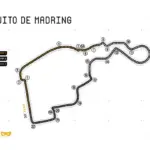
The Circuit Gilles Villeneuve in Montreal is widely liked by drivers and fans because it provides very interesting F1 races. The track mainly consists of straights and slow corners and chicanes. It is a typical “stop and go” style circuit. Overtaking in Montreal is traditionally easier, and the layout with numerous straights favors long wheel-to-wheel battles because a rival can quickly counterattack. The run to the first corner after the start is only 250 meters, so there are not many position changes then. The full characteristics of Circuit Gilles Villeneuve along with a blog schematic can be checked at this link. The most important aspects at the Canadian track are straight-line speed and traction on corner exits from slow turns. Suspension is also extremely important, as it must allow aggressive kerb riding in the chicanes. The track heavily stresses the brakes, but the many straights help cool them properly. Overtaking is possible here, so extra pit stops, especially during safety car periods, are worthwhile.
Pirelli always brings the softest tires to Canada; in 2026 these will be C3, C4, and C5 compounds. The track surface in Canada is very smooth and gentle on tires. The rear tires are the most stressed because the biggest challenge for them is traction on exits from chicanes and slow corners. Graining often appears, especially during practice sessions on a “green” track or when it is cold. The pit lane is long, but due to its specific location, the pit stop time is among the shortest in the season. Tire wear this weekend is very low, and in a dry race, a simple medium-to-hard strategy is expected. In case of safety cars, drivers will change tires twice. If it is very cold and dry, graining may appear, and then two pit stops are possible.
Sunday is expected to be very cool, only 12-13 degrees during the race. Rain is forecast from the morning hours, with light rain expected throughout the day. The track will not dry quickly, so this time Formula 1 will likely not avoid racing on a wet track. The race starts at 16:00 local time, so it cannot be delayed much in case of heavy rain. Safety cars are common in the Canadian GP, having occurred in four of the last five F1 visits. The track is tightly surrounded by barriers, so some mistakes are very costly.
Summary
After this qualifying, it can be said with certainty that the regulation changes introduced before the Miami GP are working. The Canadian track is difficult from the energy recovery perspective, and drivers drove fast and on the limit during qualifying. There was no lifting off the throttle to charge the battery. This is the kind of driving drivers and fans are used to. The fact that speed slightly dropped at the end of the long straight is related to the battery running out of energy. There is no remedy for this under current regulations; the whole battery lasts about 13 seconds. The speed drop is small, and the engine sound changes only slightly.
Regarding the race, I see two scenarios. If it is dry, like in the sprint, the front may be a bit procession-like, with everyone having similar pace and driving close but without overtaking. There will be waiting for someone to attack or make a mistake. On a wet track, anything is possible. Then there may be several crashes and numerous safety cars. The competition at the front will be open.
Did you find a mistake or typo in this or any other blog post? Highlight the word or short text fragment. If you are reading on a phone, tap the highlighted text, and if on a computer, press Ctrl + Enter, then in the window that appears, click send. You will send an anonymous report, and I will correct my mistake.
Read more How Formula 1 fans analyze risk before the Grand Prix weekend