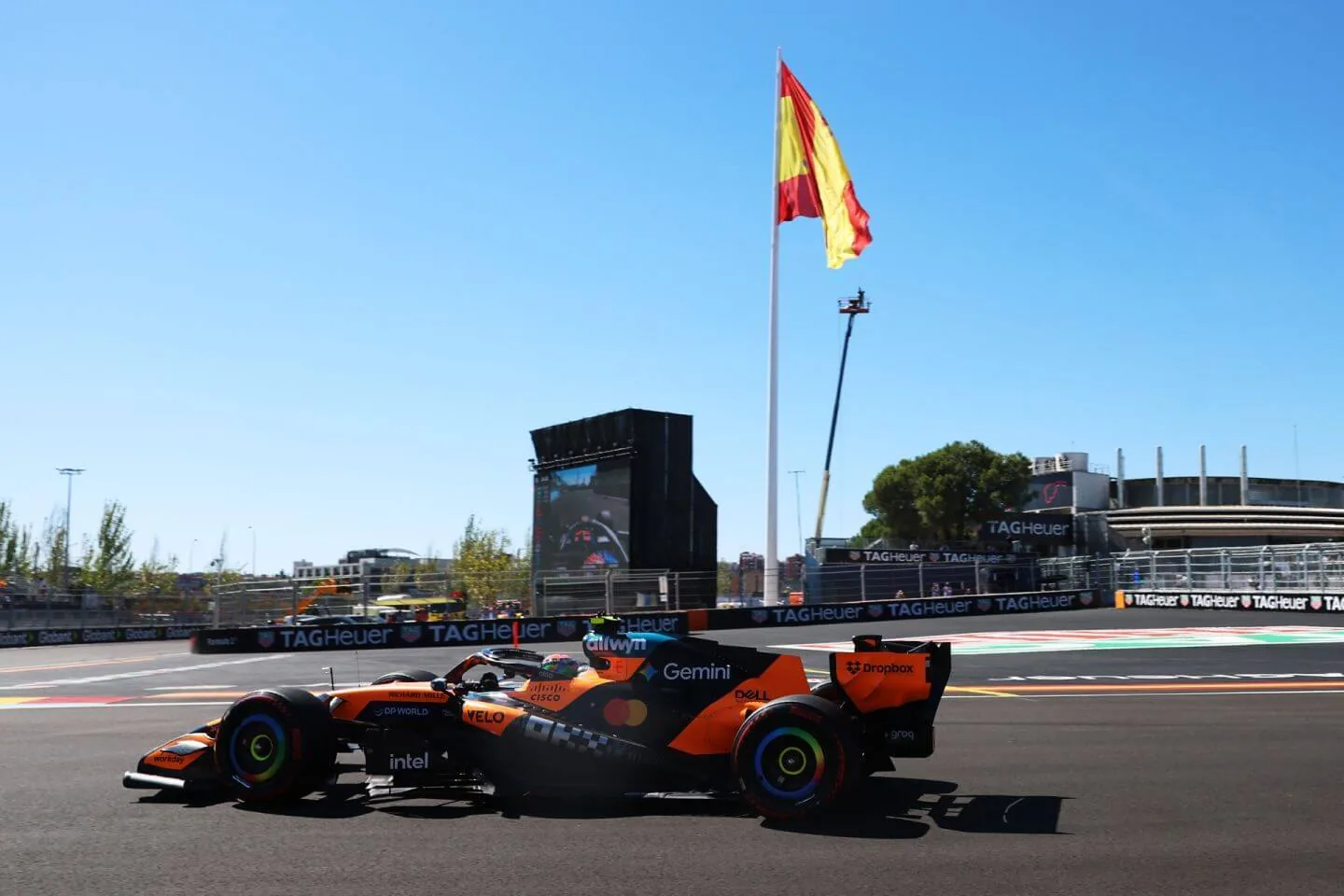

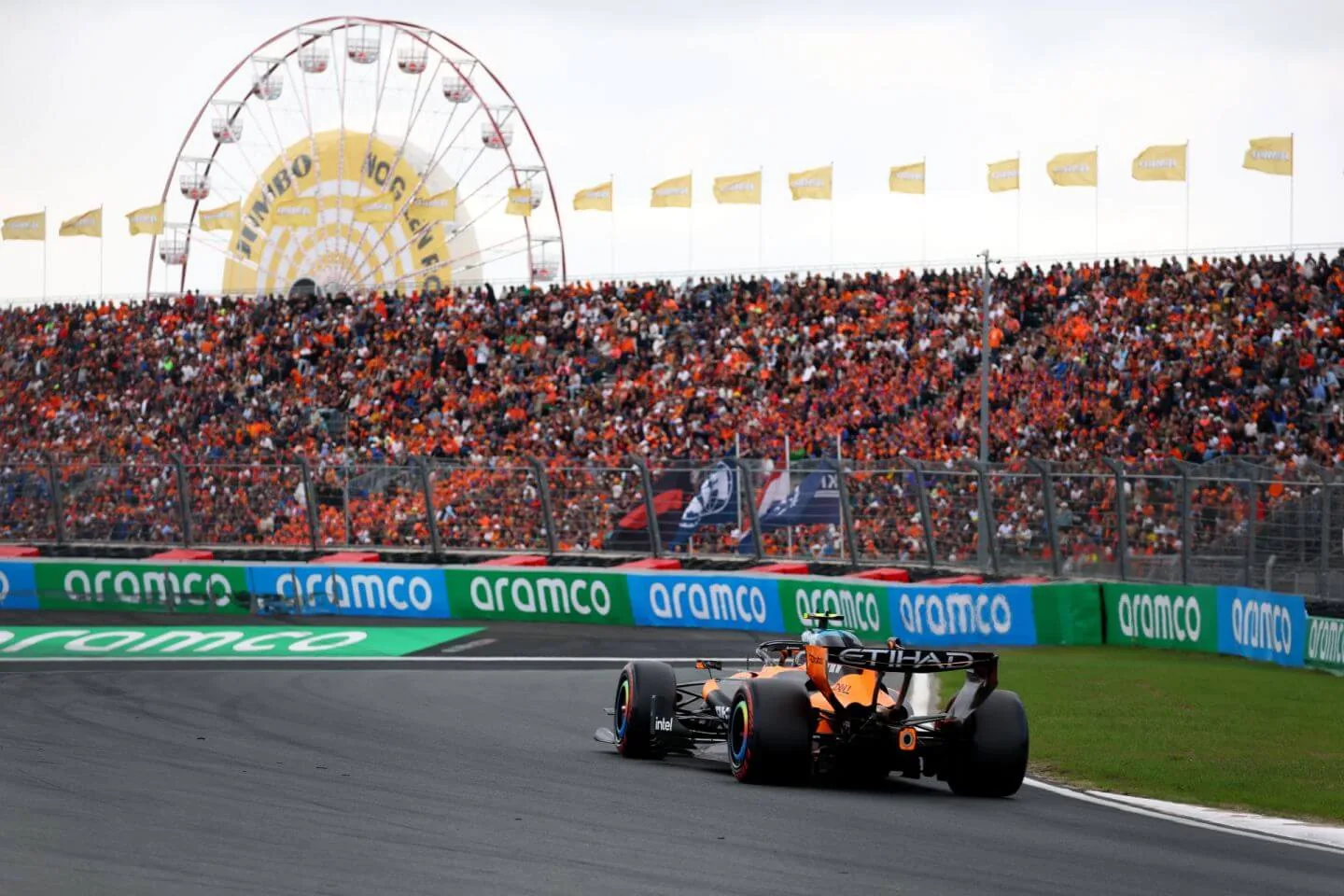
Lando Norris was the fastest in qualifying at the Zandvoort circuit, with Mercedes drivers taking the next positions. The competition at the front was very close, with eight drivers from the top teams within 0.57 seconds. Welcome to the qualifying analysis before the 2026 Dutch GP.
Read more Russell won the procession sprint before the 2026 Dutch GP
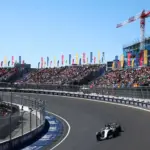
Qualifying at the Zandvoort circuit was held in sunny and fairly warm weather, with track temperatures exceeding 30 degrees Celsius. However, there were very strong gusts of wind, which is common at this venue. Towards the very end, there was a risk of rain, but it ended up just a threat. There were no interruptions, driver errors, etc., during qualifying. It was a very clean qualifying session.
Qualifying results for the 2026 Dutch GP
| Pos. | Driver | Team | Q1 | Q2 | Q3 |
| 1. | Lando Norris | McLaren | 1:12.695 | 1:11.628 | 1:11.163 |
| 2. | George Russell | Mercedes | 1:12.924 | 1:11.959 | 1:11.265 |
| 3. | Kimi Antonelli | Mercedes | 1:13.022 | 1:11.915 | 1:11.296 |
| 4. | Oscar Piastri | McLaren | 1:12.610 | 1:11.641 | 1:11.305 |
| 5. | Lewis Hamilton | Ferrari | 1:12.673 | 1:11.970 | 1:11.494 |
| 6. | Charles Leclerc | Ferrari | 1:13.064 | 1:11.910 | 1:11.558 |
| 7. | Max Verstappen | Red Bull | 1:13.290 | 1:11.874 | 1:11.618 |
| 8. | Liam Lawson | Red Bull | 1:13.392 | 1:12.301 | 1:11.733 |
| 9. | Gabriel Bortoleto | Audi | 1:13.142 | 1:12.433 | 1:12.079 |
| 10. | Arvid Lindblad | Racing Bulls | 1:13.074 | 1:12.525 | 1:12.185 |
| 11. | Pierre Gasly | Alpine | 1:13.115 | 1:12.616 | |
| 12. | Yuki Tsunoda | Racing Bulls | 1:13.085 | 1:12.627 | |
| 13. | Nico Hulkenberg | Audi | 1:13.188 | 1:12.797 | |
| 14. | Franco Colapinto | Alpine | 1:13.322 | 1:12.800 | |
| 15. | Esteban Ocon | Haas | 1:13.544 | 1:13.137 | |
| 16. | Alexander Albon | Williams | 1:13.552 | 1:13.182 | |
| 17. | Carlos Sainz | Williams | 1:13.574 | ||
| 18. | Fernando Alonso | Aston Martin | 1:13.650 | ||
| 19. | Lance Stroll | Aston Martin | 1:13.818 | ||
| 20. | Oliver Bearman | Haas | 1:13.826 | ||
| 21. | Valtteri Bottas | Cadillac | 1:14.371 | ||
| 22. | Sergio Perez | Cadillac | 1:14.600 |
Discussion of the Pole Position battle and race forecast
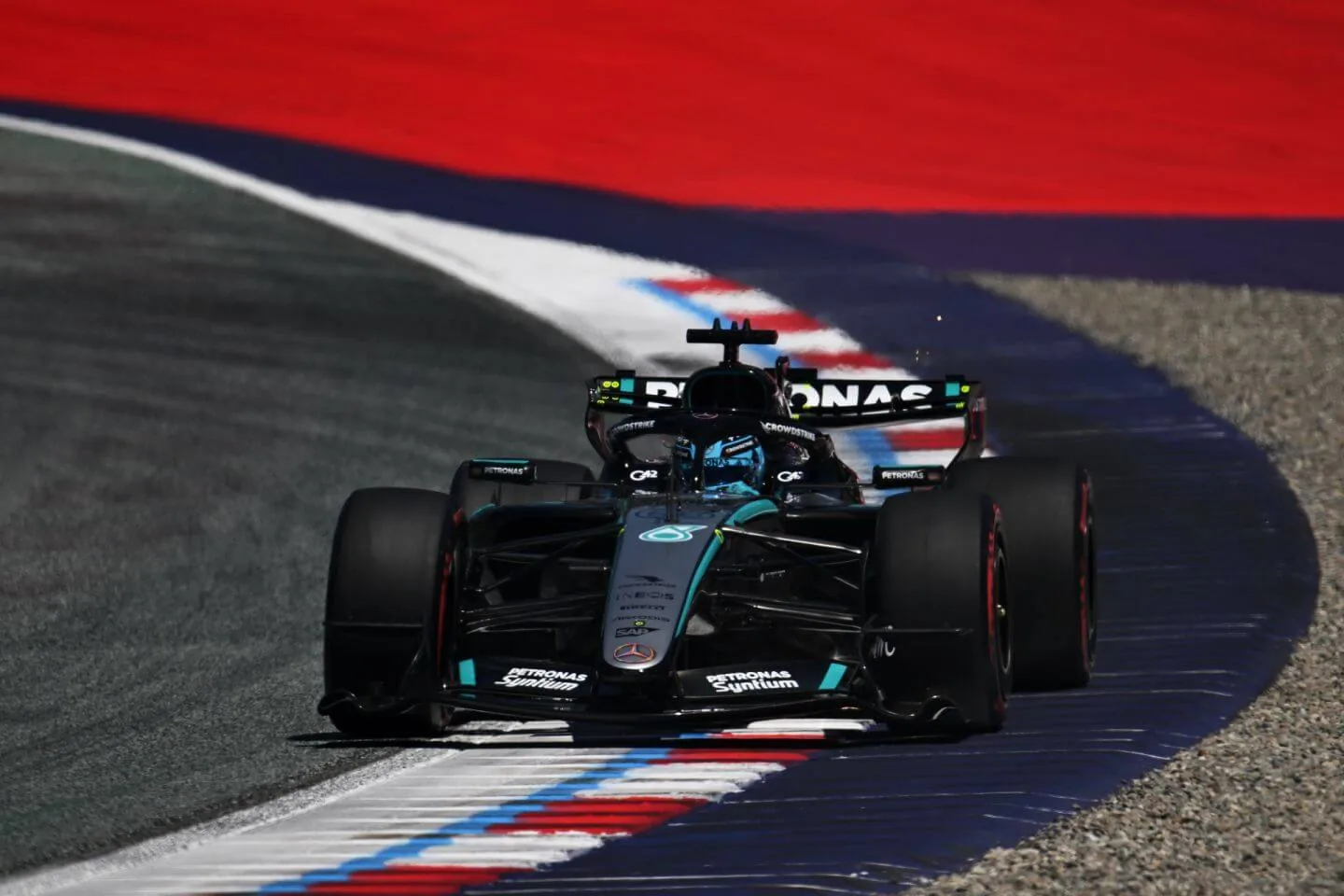
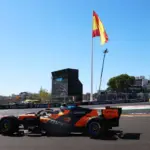
Lando Norris won qualifying and will start from Pole Position. Norris has become a specialist in time trials at this circuit, as this will be the fourth time (fifth counting the sprint) he starts the race from the front row. The Briton drove an excellent lap at the end of Q3, setting his own records in two sectors and the overall record in the second sector. It was truly a great lap from the Briton, extracting the full potential of the car. He beat both Mercedes drivers by over 0.1 seconds. The gaps in the tight front were much larger due to Norris than in Friday’s time trial. This was a qualifying session where you had to go 100%, and every mistake was costly. This is best seen with third-placed Antonelli, who made a mistake in the first sector on his final lap, costing him over 0.1 seconds. Because of this, he lost to Russell, and if he had driven cleanly, he would have been even with Norris. Russell set (like Norris) his three sector records – including the overall in the first sector, but after qualifying he mentioned a minor mistake. If we added the best sector times within the teams, Mercedes is slightly faster than McLaren. Oscar Piastri was fourth with a small gap to the Mercedes drivers. For the Australian driver, the weakest was the third sector, where he regularly lost time, so he was not fighting for PP.
In qualifying, we had an interesting distribution of strengths between the two top teams. In the first and third sectors, Mercedes drivers were the fastest. McLaren drivers lost over 0.2 seconds to them there in total. However, in the second sector, McLarens were clearly the fastest. Antonelli and Russell lost over 0.25 seconds to Norris there. It looked similar in the sprint qualifying. The cars of these teams have different strengths. McLaren is weaker in slow corners and on the straight, while Mercedes struggles more in the fastest corners.
Hamilton won a close fight against Leclerc, which is a surprise considering earlier sessions this weekend. Ferrari drivers were the only ones in the final part of Q3 to go out for a double warm-up lap, but it did not allow them to fight with the two leading teams. Ferrari is the third force in qualifying pace; they were not able to fight for more. Throughout many qualifying sessions this year, we have seen similar situations; Ferrari is unable to extract as much pace on soft tires as rivals in decisive moments. We also return to the engine deficit, which is visible precisely when driving at 100%. In the race, I expect Ferrari to take risks with strategy; they may consider more pit stops or a very early first stop. The sprint showed that they handle race pace very well, but with a classic strategy, they will not break through, so they will have to be creative.
Red Bull was the fourth force during qualifying. Liam Lawson’s result deserves great recognition, as he lost only by 0.1 seconds to Max Verstappen while driving the Red Bull car for the first time this weekend. Lawson’s performance improved his standing within the Red Bull camp. Verstappen recorded his weakest result in his career in the Netherlands, but it had to be that way. On one hand, a gap of less than 0.5 seconds to the winner is not much, but looking deeper into the results, it is clear that Red Bull is quite behind. Verstappen gained time on all straights compared to Norris but lost a lot in corners, especially the most demanding ones. Red Bull has not had significant car upgrades for quite some time and now loses a lot to the front.
The front is very close. In the sprint over a long distance, Ferrari performed very well, while McLaren was weaker. If the Woking team has not improved rear tire management, they will have a problem winning the race. Mercedes looked better in race pace and has two drivers in the front, so they will be able to play it strategically. Ferrari drivers will want to gain positions; I expect risky strategies from them, but if they get stuck behind someone for longer, the game is over. There may be different strategic plans at the front, but teams must be flexible and counter rivals’ moves. There is not much hope for direct battles; strategy will be key.
Overview of other selected drivers and teams
The midfield in qualifying consists of Audi, Racing Bulls, and Alpine teams. Yuki Tsunoda deserves considerable praise, as this weekend he is driving a new generation car for the first time and narrowly lost to Lindblad. The best from this group was Bortoleto, who on Sunday could be the leader of the second league and count on problems from front runners. Racing Bulls will fight for points. I am curious about Gasly’s form, who has a heavily upgraded Alpine car, but no significant difference was visible in the main qualifying.
Read more Russell fastest in sprint qualifying before the 2026 Dutch GP
In Q1, all Aston Martin drivers were eliminated despite Honda’s improved engine and upgraded car. They did not have large gaps to Q2, but it is clear the new package still needs significant refinement. The slowest in the field were Cadillac drivers, which we have to get used to until the end of the year. Haas and Williams teams were on the edge of advancing to Q2; ultimately, Ocon and Albon advanced, while Sainz and Bearman were eliminated. These four teams were the weakest in qualifying and form the third group.
Preview of the 2026 Dutch GP race
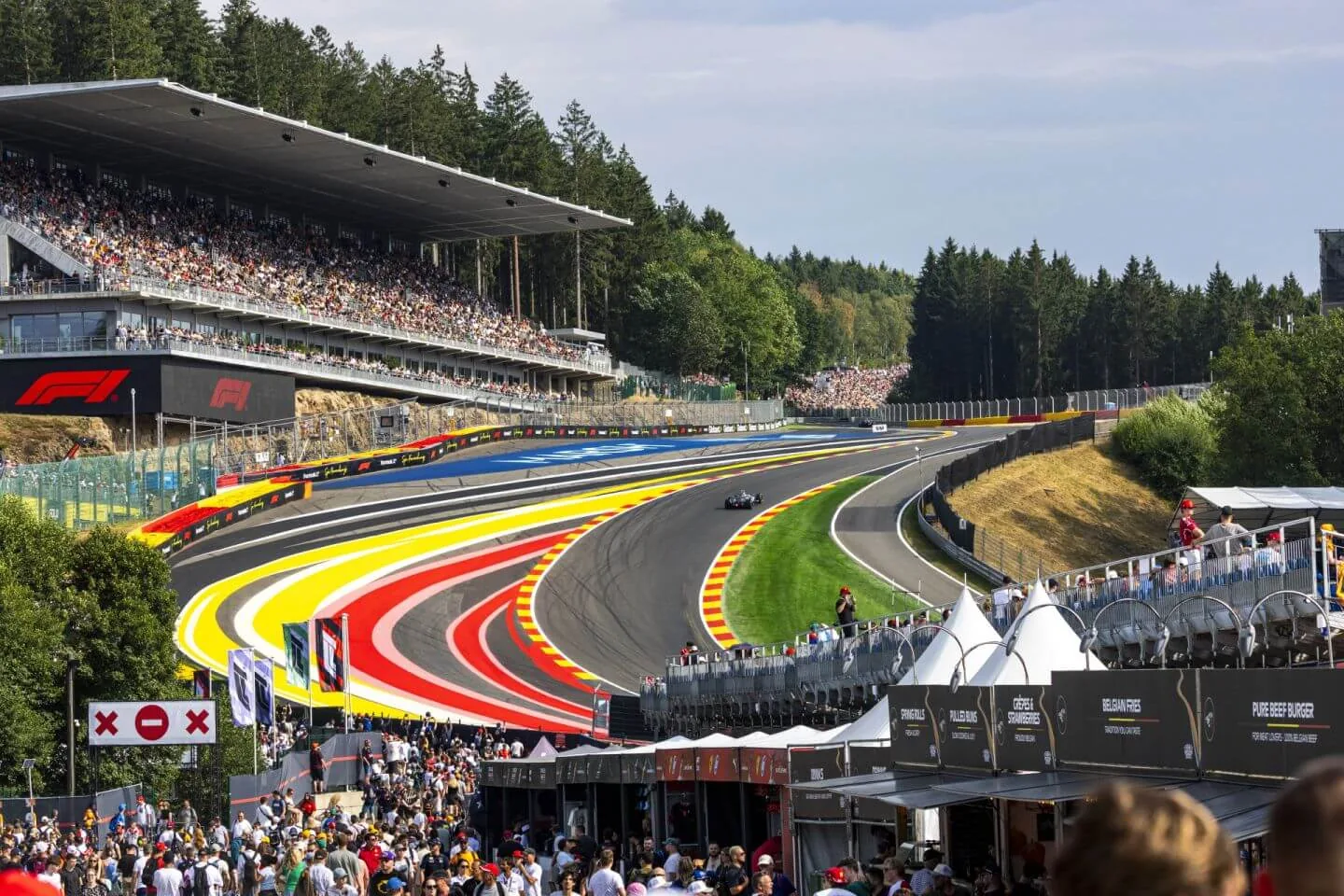
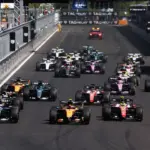
The Circuit Zandvoort in the Netherlands is an old-style track with a very flowing racing line composed of diverse types of corners. In F1 cars, many of these bends are taken with the throttle fully open. There is no room for error because gravel traps are located on the edges. Drivers really like this circuit because it is an excellent test for both themselves and the cars. Especially in qualifying, it is a great venue because at high speeds in corners on a fairly narrow track, driver precision must be at the highest level. The track is narrow, with one optimal racing line, so overtaking is very difficult. Drivers competing in similar cars can realistically fight only when braking into turn one. In other places, attacks are possible only if the rival makes a mistake or if there is a very large speed difference. The full characteristics of the Circuit Zandvoort along with a blog schematic can be checked here. At the start, drivers have to cover just under 300 meters before braking for the first corner, so there should not be many position changes. It is also very narrow there, so the chances of collisions in the first and then the third corner are very high. It is enough for someone to overdo the attack.
Pirelli brought medium tire compounds C2, C3, and C4 for the race in the Netherlands. The Zandvoort track has diverse and demanding corners and a specific surface, which subjects tires to very high loads. Especially two banked corners cause large forces on the tires. It is a circuit that stresses the front and left tires the most, so the front left tire degrades the fastest. Thermal degradation has a very large impact on the tires; if the competition takes place at high temperatures, the tires quickly lose their lifespan. If it is cooler, the tires become much more durable. The sprint showed us that it is possible to cover 1/3 of the distance without significant degradation, even on soft tires. The race will be run with one or two pit stops. All three compounds may be used. I expect that at the front, everyone will opt for two pit stops to mutually protect themselves. In case of a Safety Car, it is worth pitting, saving about 7 seconds.
Sunday is expected to be sunny but again with strong wind, and the air temperature will not exceed 20 degrees Celsius. These will be conditions very similar to Saturday. Zandvoort has often seen virtual and full neutralizations. Due to numerous gravel traps and barriers placed close in some corners, it is very easy for a reason to appear for neutralization. In a clean race, we expect a procession, but due to the high risk of neutralization, many things can happen.
Summary
Since the Zandvoort circuit returned to the F1 calendar in 2021, all races (and sprints) have been won from Pole Position. Lando Norris is therefore the main favorite, but some uncertainty is introduced by problems with excessive tire wear during the sprint. I hope that F1’s farewell to this circuit during the race will be interesting and not a procession like during the sprint. Different strategies may be in play, and there is also a significant risk of neutralization.
If you found a mistake or typo in this or any other blog post, highlight the word or a short fragment of text. If you are reading on a phone, tap the highlighted text, and if on a computer, press Ctrl + Enter. In the window that appears, click send. You will send an anonymous report, and I will correct my mistake.