





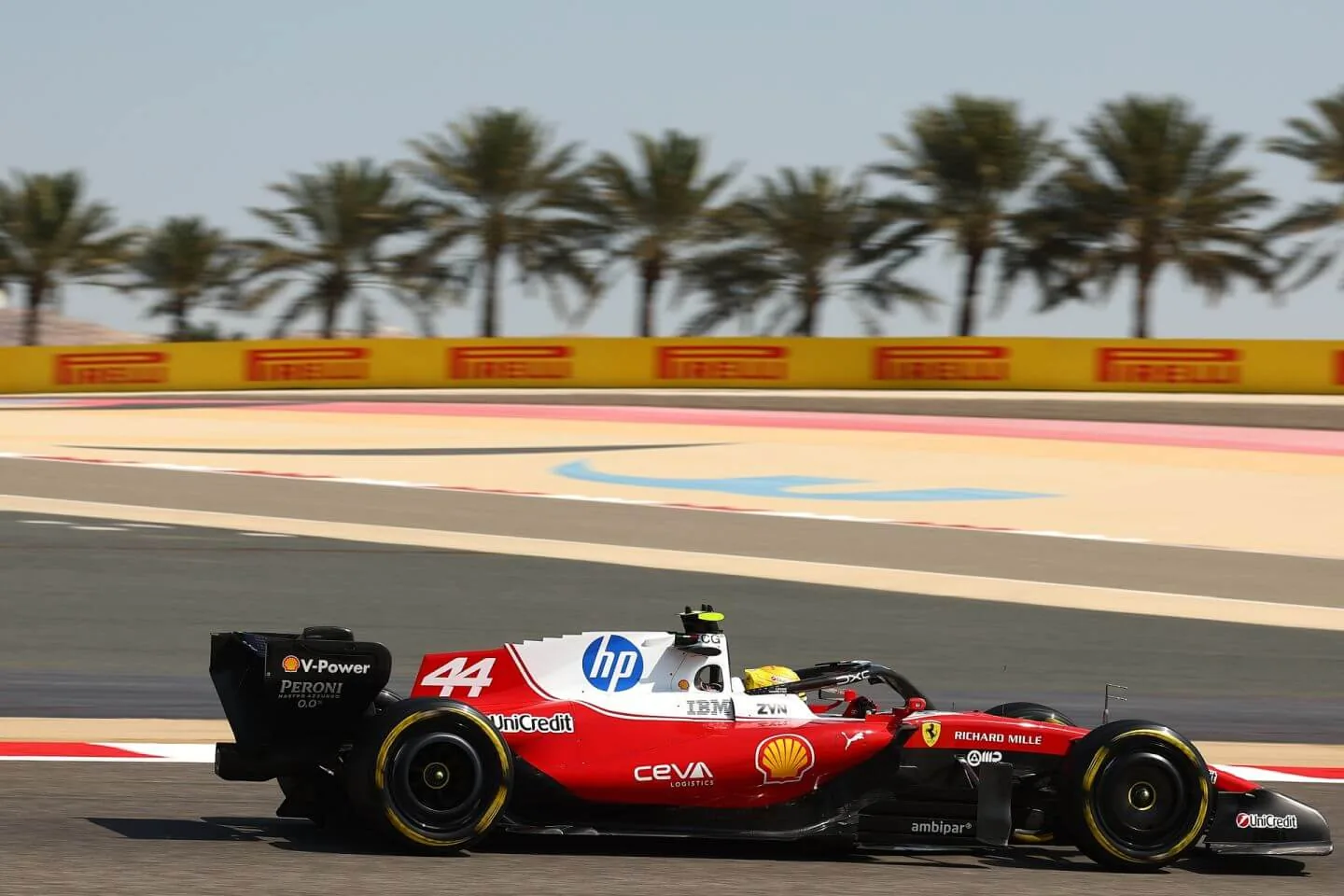
The strength of teams using the Ferrari power unit in 2026 should be race starts, aided by a different turbocharger design. Pre-season testing confirmed this, as the Ferrari factory team performed best during practice starts.
Read more Ferrari should have an advantage at the start in 2026
If anyone watched the final round of pre-season testing in Bahrain, practice starts were performed at the end of each session. Drivers using Ferrari engines performed best in them. The factory team led the way, and Haas also performed well. Cadillac is the weakest or nearly the weakest in the entire field, so in their case, it doesn’t matter significantly. There have even been suggestions that Ferrari drivers will regularly lead into the first corner, even if they start from, for example, the second row. In my opinion, this won’t be a rule, as there remains the issue of a perfect start on the driver’s part, as well as the behavior of competitors who might start better or block cleverly.
Turbo lag effect in F1
Formula 1 has been using turbocharged engines since 2014. In these types of engines, the so-called turbo lag effect occurs. It is a delay in the response of a turbocharged engine to pressing the accelerator pedal, manifesting as a temporary lack of power when accelerating from low RPM. In the years 2014 – 2025, the MGU-H system, or Motor Generator Unit – Heat, was used in F1 power units. One of its applications was powering the turbocharger, so there was no turbo lag at all, and this topic completely didn’t exist in F1. From 2026 and the introduction of new power units, the effect has returned because there is no MGU-H system. This is no surprise; it was one of the main objectives of the regulations. The MGU-H system was abandoned to simplify the engines, as it was a very complicated technology blocking the participation of new manufacturers.
The turbo lag effect is well known in F1 from the 80s when turbocharged engines were used; it forced a specific driving style on drivers back then, which is returning in a modified form in 2026. To keep the turbocharger RPM high, drivers use lower gears than before when cornering (resulting in higher engine RPM), and during a standing start, they must spool up the turbocharger, which takes several seconds. The tactic of taking corners in lower gears is not a matter of driver skill, as some thought during testing, but rather the requirements of a specific power unit. The fact that driver X takes a corner in first gear while others are in second doesn’t mean driver X is smarter than them. Power units have different requirements. Teams also use different gearbox ratios (they are the same for the entire season, so they require clever planning as early as February). Reportedly, drivers using Ferrari engines use higher gears in corners, precisely because of the different turbocharger.
According to the regulations, the maximum turbocharger speed is 150 000 rpm (revolutions per minute) in 2026.
Where does Ferrari’s advantage at starts come from?
According to media reports, the Ferrari power unit has a slightly smaller turbocharger than other engine manufacturers. A smaller turbocharger spools up faster, requires less energy, and reaches the appropriate boost more quickly. Of course, this is F1, so we are talking about small differences in construction, but they are decisive. When cornering during competition, this won’t be significant, but during race starts, it will be. This will be a constant advantage, as changing the turbocharger size during the season would be very difficult (if at all possible, as many power unit components cannot be changed during the season). Other manufacturers had different assumptions when designing their turbochargers. Everything has its pros and cons. According to The Race, Ferrari also used a smaller turbo in previous regulations, but back then it didn’t have a significant impact on performance because of the MGU-H.
Drivers start the race using only the internal combustion engine and the turbocharger. Electric power from the MGU-K system can, according to the regulations, be used for propulsion after reaching a speed of 50 km/h. Therefore, even a slightly better response thanks to the turbocharger and internal combustion engine gives drivers using Ferrari engines an advantage along the entire straight until braking. Electric energy is limited, so a better response from the internal combustion engine and turbocharger counts. I don’t expect anyone to not use electric energy at the start to save it for the rest of the first lap, because such a person would suffer heavy losses before the first corner.
Drivers at the start will have to bring the turbocharger to optimal RPM, which takes about 10 seconds. For those starting at the front of the grid, this isn’t a problem, but those at the back might run out of time. Hence the testing of a new procedure and giving drivers an additional five seconds before the start of the lights-out sequence. Ferrari prepared well for the starts; a year ago they raised the issue during an F1 Commission meeting, but their suggestions were ignored. Now a regulatory change is possible to introduce, but Ferrari can block it with its right of veto. On the other hand, the FIA can change the regulations at will regarding safety. If unpleasant situations occurred at the start of races at the beginning of the season, the FIA could intervene and change the starting procedure. This would level the playing field, but Ferrari should maintain a slight advantage at starts.
The Ferrari SF-26 is a very interesting car with various innovations. Details on two of them introduced in Bahrain.
Summary
In 2026, prepare for louder starts, but it will be a specific sound that not everyone might like. 22 cars will be spinning their turbochargers to maximum RPM for several seconds before they move, so it will be loud.
Of course, in F1, no one stands still. I am sure that all engine manufacturers and all teams are working on appropriate settings and procedures to improve their starts. Drivers always do specific things on the formation lap and once they have lined up on their grid spots. In previous years, keeping tires at the right temperature usually made the difference, but this year, engine preparation may play the main role. Personally, I expect rivals to prepare appropriate procedures and Ferrari’s advantage at starts to decrease, but it should still be present. I remember how in 2009 only a few drivers used the KERS system and always gained at the start because rivals were unable to defend themselves. In 2026, there will be no such guarantee, but if we look at the average gains/losses at the start at the end of the season, drivers with Ferrari engines will, in my opinion, come out on top.