
Kimi Antonelli won the qualifying at Silverstone ahead of two Ferrari drivers. The top results saw some minor changes compared to Friday’s competition. Welcome to the qualifying analysis before the 2026 British GP.
Read more Leclerc won the surprise-filled 2026 British GP
Qualifying at Silverstone was held at a very similar temperature as on Friday – the track surface was around 40 degrees Celsius. However, it was windier. The start of Q2 was delayed by a few minutes because the marshals had to clean gravel brought onto the track.
Qualifying results for the 2026 British GP
| Pos. | Driver | Team | Q1 | Q2 | Q3 |
| 1. | Kimi Antonelli | Mercedes | 1:29.719 | 1:28.493 | 1:28.111 |
| 2. | Charles Leclerc | Ferrari | 1:29.534 | 1:28.626 | 1:28.286 |
| 3. | Lewis Hamilton | Ferrari | 1:29.644 | 1:28.864 | 1:28.458 |
| 4. | George Russell | Mercedes | 1:29.985 | 1:28.920 | 1:28.481 |
| 5. | Isack Hadjar | Red Bull | 1:29.276 | 1:29.069 | 1:28.746 |
| 6. | Lando Norris | McLaren | 1:30.186 | 1:29.383 | 1:28.877 |
| 7. | Max Verstappen | Red Bull | 1:29.549 | 1:29.113 | 1:28.893 |
| 8. | Oscar Piastri | McLaren | 1:29.971 | 1:29.218 | 1:29.032 |
| 9. | Arvid Lindblad | Racing Bulls | 1:29.661 | 1:29.324 | 1:29.305 |
| 10. | Liam Lawson | Racing Bulls | 1:29.300 | 1:29.429 | 1:29.716 |
| 11. | Gabriel Bortoleto | Audi | 1:30.269 | 1:29.461 | |
| 12. | Pierre Gasly | Alpine | 1:30.345 | 1:30.063 | |
| 13. | Nico Hulkenberg | Audi | 1:29.539 | 1:30.076 | |
| 14. | Oliver Bearman | Haas | 1:30.570 | 1:30.501 | |
| 15. | Carlos Sainz | Williams | 1:30.562 | 1:30.623 | |
| 16. | Alexander Albon | Williams | 1:30.638 | 1:31.341 | |
| 17. | Esteban Ocon | Haas | 1:30.680 | ||
| 18. | Valtteri Bottas | Cadillac | 1:31.227 | ||
| 19. | Franco Colapinto | Alpine | 1:31.321 | ||
| 20. | Sergio Perez | Cadillac | 1:31.451 | ||
| 21. | Lance Stroll | Aston Martin | 1:32.863 | ||
| 22. | Fernando Alonso | Aston Martin | 1:33.025 |
Fight for Pole Position and race forecast for the front runners
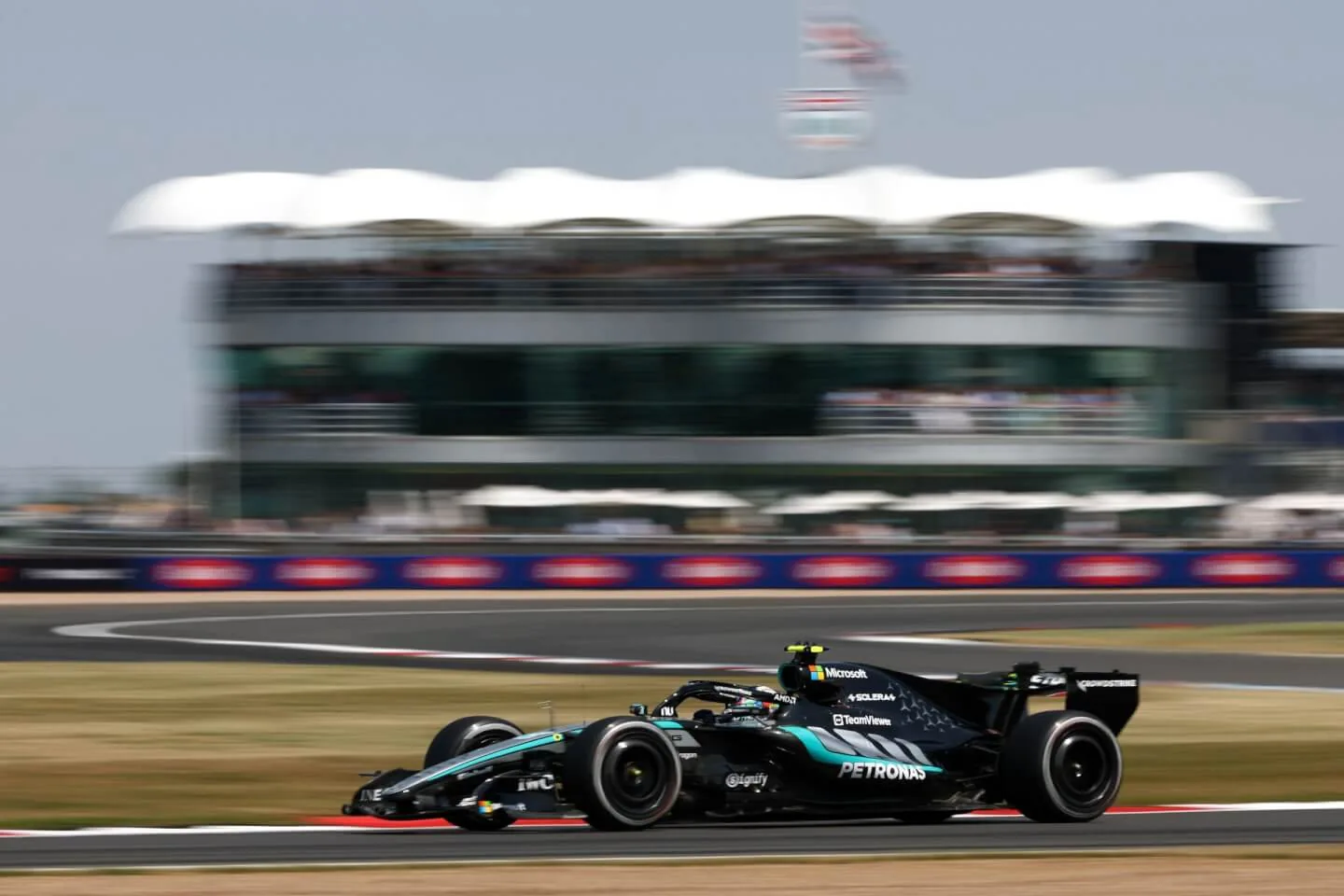
The main qualifying did not provide great excitement from my perspective, as the front runners spread out and there was not much direct battle. Mercedes did their homework, better utilizing electric energy over the lap distance, neutralizing Ferrari’s advantage from Friday. This secured Antonelli Pole Position with a significant margin. The Italian clearly improved compared to Friday’s qualifying (comparison below), had overall records in the first and second sectors, and lost only to Hamilton in the third. It was a very confident victory.
Second place went to Charles Leclerc, which is a positive surprise. The Ferrari driver introduced some changes to the car that worked. Looking at the detailed comparison, he had an advantage in most corners but ultimately had no chance to fight for PP. The key was the third sector, where he lost too much time on both straights, clearly lacking electric power in the engine. However, Leclerc must be very pleased; he drove much better than on Friday and beat Hamilton. This could be a breakthrough for him after a series of weaker results.
Lewis Hamilton won Friday’s qualifying but was only third in the main session. The Briton drove slower than on Friday. I got the impression that Hamilton wanted to try something different, experimenting with various solutions in the fight for PP. On his best lap, he had a personal best only in the first sector, and in the next two, he was slower than before. He had the potential for a better result, but even Friday’s time would not have allowed him to beat Leclerc.
For Ferrari, these were very successful qualifying sessions. They have a really good car aerodynamically and mechanically, probably the best in the field. The results from Silverstone suggest that this car is aerodynamically efficient, meaning it has the most favorable downforce-to-drag ratio. They still lack combustion engine power and more efficient energy recovery.
The situation with George Russell looks interesting. The Briton complained this weekend about his straight-line speeds; I ignored it, considering it a typical excuse drivers often use. However, looking at the telemetry, Russell was only slightly slower than Antonelli after two sectors, but in the third sector, he lost nearly 0.3 seconds, and this loss comes from the two straights. He drove very similarly to Antonelli, using electric power almost the same, but then Antonelli pulled away in the third sector. It seems to me that Russell has some problem with car setup. Antonelli would be better than him anyway, but Russell should be much closer. Russell saved himself in Q1 when after a small mistake he went off onto the shoulder.
Mercedes and Ferrari fought each other in this qualifying; there is a chance it will be similar in the race. For me, Antonelli is the clear favorite to win, and Russell should break through to second place. The sprint showed us that Mercedes has the best race pace thanks to having more energy available (in qualifying you can recover 6.5 MJ, and in the race 8.0 or 8.5 in overtaking mode), and tire wear plays a marginal role. Ferrari drivers must count on the start to gain positions and then try to make it as difficult as possible for Mercedes. I also expect them to take a risk with a different strategy, trying to gain something. Knowing Mercedes, they will rely on their pure speed using a safe one-stop strategy with intermediate and hard tires.
Comparison of times in both qualifying sessions
Below is a comparison of times achieved by drivers of the four leading teams in Saturday’s qualifying compared to Friday’s sprint qualifying.
Antonelli – faster by 0.265 seconds
Leclerc – faster by 0.417 seconds
Hamilton – slower by 0.082 seconds
Russell – faster by 0.252 seconds
Hadjar – faster by 0.089 seconds
Norris – slower by 0.137 seconds
Verstappen – slower by 0.196 seconds
Piastri – slower by 0.260 seconds
Overview of other selected drivers and teams
In qualifying, I was disappointed by Red Bull and McLaren teams, whose drivers lost a lot. In this group, only Isack Hadjar deserves praise; he drove very nicely, pushed to the max, and beat Max in the second Red Bull car. Verstappen has not lost to his teammate in Q3 for a very long time. The Dutchman complained throughout the session about car problems, which were probably the cause. Red Bull disappointed me because in Austria they introduced a very large upgrade package that gave noticeable gains there, and Verstappen fought for the win. At Silverstone – a different type of track – they again clearly lag behind. Over 0.6 seconds loss is a very big difference in current F1. Probably their modified aerodynamic package is not yet fully refined.
Read more A handful of F1 Circus statistics after the 2026 British GP
McLaren drivers complain about lack of grip; at this track, their aerodynamic shortcomings and the limitations of the Mercedes engine are evident. It looks very poor, so I wonder how Norris was third in the sprint. The main qualifying excludes them from fighting for such a good race position. The only hope will be much better race pace thanks to the Mercedes engine.
Again, Racing Bulls drivers advanced to Q3 as a complete set, confirming very good form. There will be a chance for double points in the race. Gabriel Bortoleto was very close to advancing to Q3; he admitted it was his fault because he made one mistake over the distance. Audi overall looked good; they should be in the points fight on Sunday, important not to lose anything at the start. Haas and Williams teams are typical midfield, fighting to advance to Q2, with no chance for Q3. Alpine disappointed because Colapinto was out in Q1 after his own mistake, and Gasly received a three-place grid penalty on Sunday for blocking a rival.
At the bottom is Aston Martin, whose drivers already have a huge gap to Cadillac. At the end of the month, we will see how the B version of the car will perform, which is supposed to bring a big improvement in pace. For now, they are not fighting for anything. Cadillac, after major changes introduced in Austria, shows better form but still lacks a lot to advance to Q2.
Preview of the 2026 British GP race
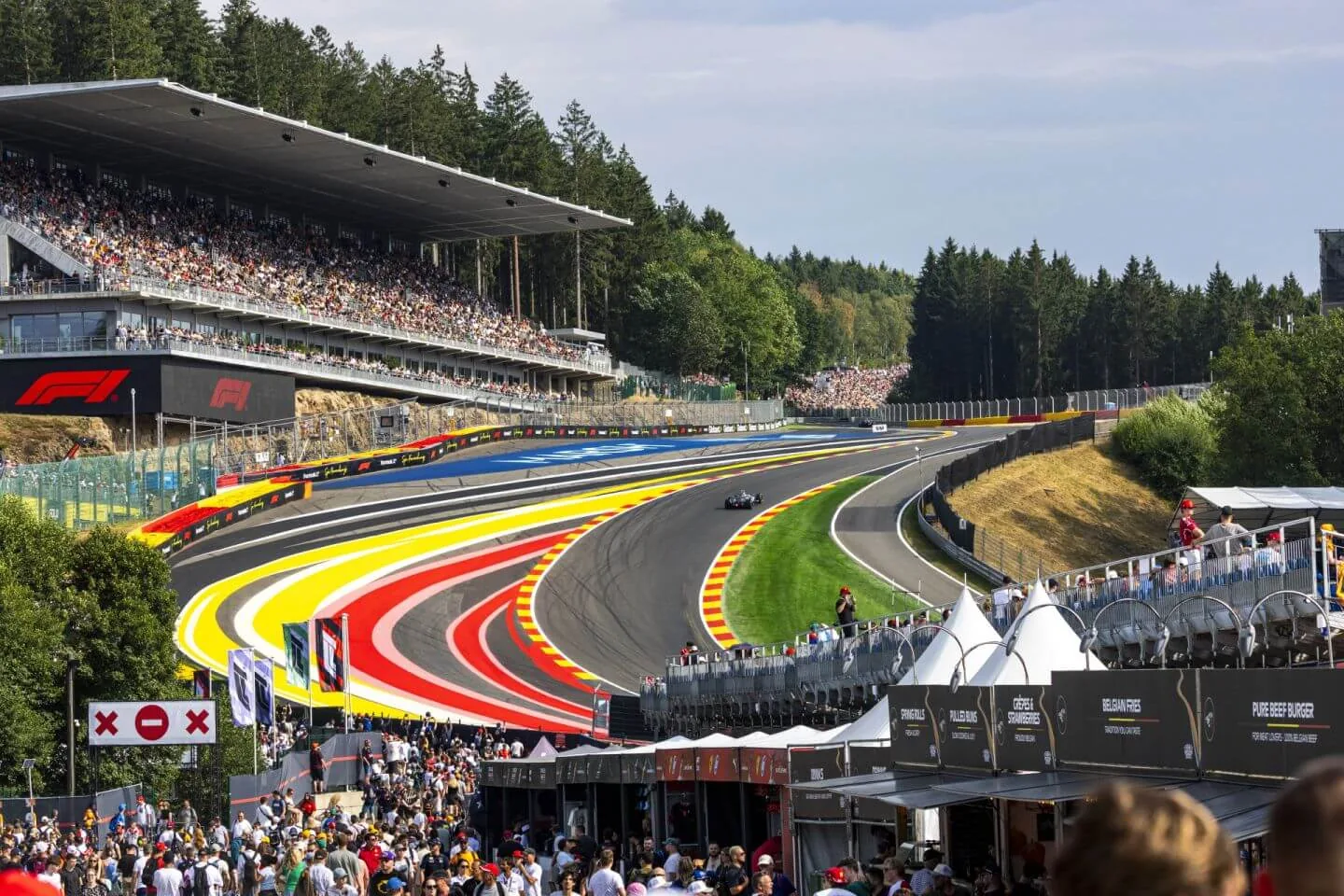
Silverstone Circuit is one of the fastest venues on the Formula 1 calendar. The straights at Silverstone are relatively short (the longest is about 850 meters) but usually lead into fast corners, so the real length of full-speed driving is longer. Nearly 80% of the lap distance in qualifying is covered with the throttle fully open, one of the highest values on the calendar. The track layout for F1 cars is great except for the lack of elevation changes, as the track was laid out on a flat area of a former airfield. The best cars at Silverstone are those with the best aerodynamic efficiency, meaning the most favorable downforce-to-drag ratio. The track places very low demands on the braking system because there are very few heavy braking zones. The full Silverstone Circuit characteristics along with a blog schematic can be checked here.
Historically, this is not a venue where overtaking is easy because there is only one place requiring very heavy braking. Additionally, the track is very smooth and fast. At the start of F1 races, there are often many position changes and collisions because drivers go through the first two corners with little or no lifting, and heavy braking only comes at corner three, which can be taken with different racing lines. New power units from 2026 will lead to significantly more position changes over the race distance. It is a long track, making optimal energy use planning difficult; there will be differences between drivers, leading to overtaking.
Pirelli brought the hardest tires to Silverstone in 2026. It is one of the most demanding tracks for tires on the calendar. At this track, the front tires are especially stressed, with emphasis on the front left. In the last several years, there have been several tire failures caused by excessive load. For this reason, Pirelli is always cautious, imposing very high pressures to make the tires harder. This usually results in a one-stop strategy here. The Saturday sprint confirms this. On intermediate tires, according to simulations, it is possible to cover more than half the distance without problems. The optimal strategy is intermediate – hard, but some drivers may risk soft – intermediate or intermediate – soft strategies. A two-stop strategy in a clean race makes no sense. In case of SC or VSC, it is worth visiting the pits because the pit lane time loss is relatively short, making it almost a free tire change.
Warm weather is expected during the race, with 26-28 degrees Celsius and the track heating up to 40 degrees. These are ideal conditions for F1 cars, with no problems of overheating cars or tires. In recent years at Silverstone, there have been many crashes and failures, and the SC appeared in four of the last five F1 races. There is a high chance of crashes here, and wide gravel traps mean it is easy to get stuck off track.
Summary
The sprint largely showed the balance of power and that driving in clean air is key. If someone gets involved in direct battles at the start, where it is easy to be countered and drivers exchange positions, they will lose a lot of time. Every front-runner will want to avoid this. I will be very surprised if Antonelli does not win the race and if Mercedes does not have a one-two finish.
On Saturday at Silverstone, a sprint was held, and on Friday, sprint qualifying. Summaries and results of these sessions can be found here.
Read more Carlos Sainz – from the son of a famous driver to the eternal Plan B