
Formula 1 is a competition for fractions of a second, which are sometimes achieved in very interesting ways. In 2026, the innovation is a qualifying trick related to the use of electric energy in the last meters of the timed laps. Mercedes is the leader, the rest of the field must catch up after the summer break.
Read more McLaren changes the car concept for 2027 because a shorter car costs it downforce
In the technical regulations, there is the possibility of completely switching off the electric drive MGU-K when there is a risk of failure. The driver can completely turn off this system. FIA expected before the season that teams would abuse this option, so a safeguard was introduced that when such a shutdown occurs, the electric drive (350 kW power) cannot be used for 60 seconds. So if someone decides to turn off the MGU-K, they only have the combustion engine to drive. FIA expected that such rules would cause no one to abuse it because it would bring more losses than benefits, but engineers in F1, as always, came up with something interesting.
Qualifying trick at the beginning of the 2026 season
Teams are always one step ahead of FIA. Mercedes and Red Bull during the March races in Australia and Japan used the above option, which is referred to in the media as a “qualifying trick.” They did not use it in China because the track layout there is unfavorable at the end of the lap, so it was not profitable. Drivers of the mentioned two teams tested the trick in practice and tried to use it in qualifying, but not always. It seems to me that some drivers from customer teams also tested this solution.
Engineers concluded that the existing option to switch off the MGU-K can still be used, but only at the very end of the timed lap in qualifying. Later, the electric drive is lost, but on the slow in-lap it does not matter. And what was this trick originally about? When during the qualifying lap the driver approaches the limit of electric energy use, its power is reduced by 50 kW per second to avoid a sudden drop in power to zero, which would be dangerous. However, if the driver manually switches off the MGU-K, there is no automatic gradual power reduction per second, but the battery is emptied to the end at the maximum power of 350 kW. Switching off the system at the right moment allowed having 50 to 100 kW more electric power available for a very short moment than with the standard gradual drop. This translated into time gains measured in hundredths of a second, and perhaps around one tenth. In F1, the fight is for the smallest fractions of a second, so teams used this. The principle is simple: it is better to have more power at the beginning of the straight because it allows the car to accelerate more, so this trick worked.
Because completely switching off the electric drive is dangerous (especially at Suzuka it was visible when drivers were going very slowly in corners in the first sector), FIA after pressure from some teams (Ferrari) banned this practice in April. An instruction (probably a technical directive) was sent to the teams that manual switching off of the MGU-K may only be possible in case of technical problems (Source). FIA’s action was effective because from the Miami GP no one did this anymore, but after a few weeks a new method appeared.
New Mercedes qualifying trick from the British GP
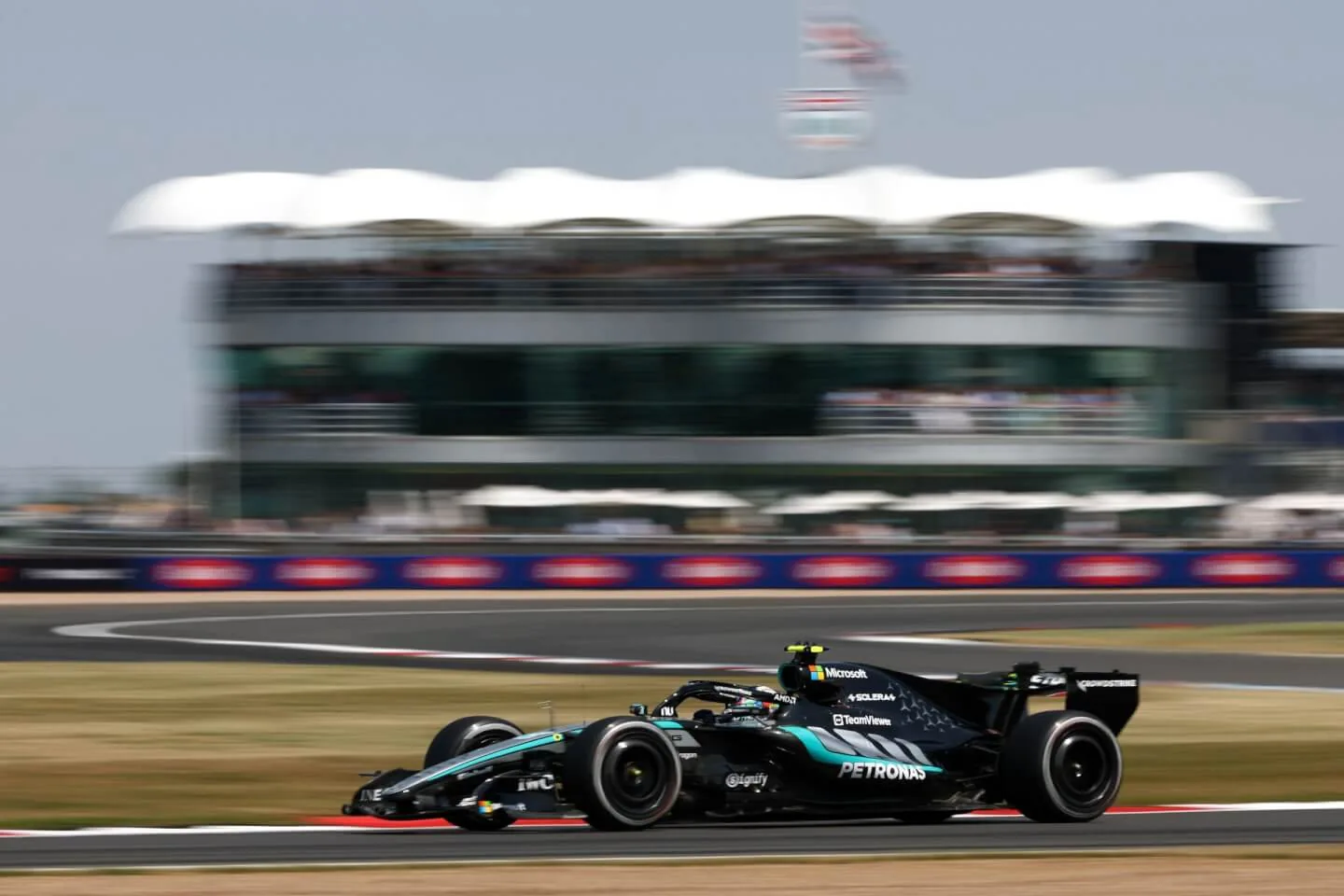
The factory Mercedes team found a new way to use the qualifying trick from the British GP at the Silverstone circuit – the layout of this track is favorable for such maneuvers. Drivers of this team released the throttle pedal just before crossing the finish line. Releasing the throttle causes the car to start slowing down because it does not use the full power of the power unit. So this tactic means losing time in the last several dozen meters of the timed lap. Why did Mercedes do something so strange? According to the current regulations, electric energy at the end of the lap drops by 50 kW per second during normal full-throttle driving. However, if the driver completely releases the throttle before fully emptying the battery, it does not enter the mode of gradual electric power reduction. It is fully legal and compliant with the regulations.
Mercedes drivers must therefore release the throttle at a very specific moment at the end of the timed lap in qualifying. In this way, they lose some time in the last several dozen meters but at the same time can use full electric power (350 kW) a little longer on the exit of the last corner, so at the moment of releasing the throttle the whole car is more accelerated than during standard driving. It is not as beneficial as the version of the trick from the March races, but it allows gaining time over rivals. They must have software prepared for such driver behavior in the last meters, i.e., to deliver full electric power to the drive earlier.
Read more Online Casino Budget During the Grand Prix – Deposit Limits and Expense Control
It is very difficult to precisely determine the time gains because much depends on the exit from the last corner onto the final straight, as well as how much electric energy the driver has left for this short section. I compared laps of several drivers in qualifying for the sprint and in the main qualifying at Silverstone to Antonelli’s laps (Russell also did this but was slower than the Italian) and estimate that the gain was up to 0.1 seconds per lap. In some cases, the gains were slightly higher, and in others slightly lower. One tenth of a second is a significant gain considering the balanced field this year. In qualifying for the Belgian GP, Mercedes drivers also did this; there Antonelli’s gain over the front rivals was greater, I would estimate it at 0.15 to 0.2 seconds. Russell, despite the same driving, lost more because he had battery problems. In the data from qualifying for the Hungarian GP (I only look at the fastest laps) I do not see Mercedes drivers releasing the throttle before the finish line. Norris slightly released the throttle in the front group, but not to zero and literally in the last meters, so that was something else. At the Hungaroring, there was a lot of electric energy, enough for the whole lap, so there was no point in thinking about such a trick.
Using this trick is very risky because it requires the driver to release the throttle at a specific moment. If done too early or too late, the driver may lose time or even break the regulations. Therefore, it requires precise software preparation and driver training during simulator sessions. According to unofficial information, Mercedes drivers receive an audio signal in their headphones when to release the throttle.
According to The Race service, using this trick gives a gain of about 0.05 seconds, which is less than I wrote above when estimating time differences in the last meters of qualifying laps. Considering the balanced field this year, it is worth refining such a driving method and implementing it because less than 0.05 seconds often decides final positions.
Summary and possible wider use of the trick in the second half of the season
According to The Race service, Ferrari drivers tested the identical throttle release tactic before the last corner during practice at the Hungaroring. They did not do this in qualifying because, as I mentioned above, such a strategy did not bring benefits on this track – there is a lot of electric energy there. It cannot be ruled out that drivers from other teams tried something similar; it would be necessary to manually check telemetry records during various practices to be sure.
The benefits of using such a trick are noticeable only on selected tracks. The distance between the last corner and the finish line must be relatively short, and additionally, the track configuration must be less favorable for energy recovery, i.e., the energy is not enough for the entire distance. Looking at the next tracks, we can notice throttle release before the finish line in qualifying at Monza, then Sepang in Malaysia. In the Netherlands, Madrid, and Singapore, there is a lot of electric energy, and in Azerbaijan, a huge straight leads to the finish, so it will not make sense there. We will see if anyone else wants to implement it.