


The FIA World Motor Sport Council has approved a compromise solution that will gradually change the power ratios of power units in F1 in 2027 and 2028 to 60/40. These are very good changes with one side effect in 2027. Power units in 2028 will be real rockets.
Read more Williams and Aston Martin’s months-long problems in 2026
At the beginning of May, the F1 Commission approved a series of regulatory changes aimed at changing the power ratio generated by power units to 60/40 from 2027 – details. This was then announced as a success for the whole sport, but when everyone returned to their teams and analyzed the arrangements, some manufacturers withdrew their support because the planned changes would negatively affect their competitiveness. According to media reports, only Mercedes and Red Bull Ford continued to support these changes (they have the best combustion engines, so the increase in their importance is beneficial for them), and the rest withdrew for various reasons. I will not go back to the specific reasons here, but after a few weeks a compromise was reached. Partial regulatory modifications will be introduced in 2027, and full ones in the 2028 season. The FIA World Motor Sport Council approved a series of regulatory changes at its meeting on June 23, 2026 – Source. At the time of writing this article, updated technical regulations have not yet been published, so we do not know 100% what will change, but the FIA statement presents the effects of these modifications.
Evolution of power units in F1 in 2027 and 2028 approved
The FIA approved many changes in all regulations to be able to change the power ratios of power units, so discussions were heated because it will affect the balance of power, competitiveness of individual engines and cars, as well as team finances. The changes are very good for the whole of Formula 1, but not for every team/engine. Therefore, teams negotiated so that the regulatory modifications would be most beneficial for them.
The changes are twofold, as the power of combustion engines will be increased and the hybrid power limited. Combustion engines will be stronger because the available fuel dose has been increased: by 5% in 2027 and by 13% in 2028. The maximum power of combustion engines will thus increase to 450 kW. FIA’s calculations are very conservative, based on the currently weakest combustion engines, which have about 400 kW in 2026. FIA also ignores the natural development of engines; realistically, the power of the best will be significantly higher, at the level of 480 – 500 kW (650-680 horsepower) in 2028. This will make the power ratios even more favorable to combustion engines than the target 60/40, more like 62/38 or 63/37.
The maximum electric power in default mode will be limited from 350 kW to 300 kW from 2027. The 350 kW level will be maintained in overtaking mode, which should facilitate attacking rivals because there will be a greater power difference between cars than currently. At the same time, the energy recovery capability will gradually increase from 350 kW in 2026 to 375 kW in 2027 and 400 kW in 2028. If someone has to deliberately recover energy while driving, they will do it for a shorter time than currently, so it will be less noticeable.
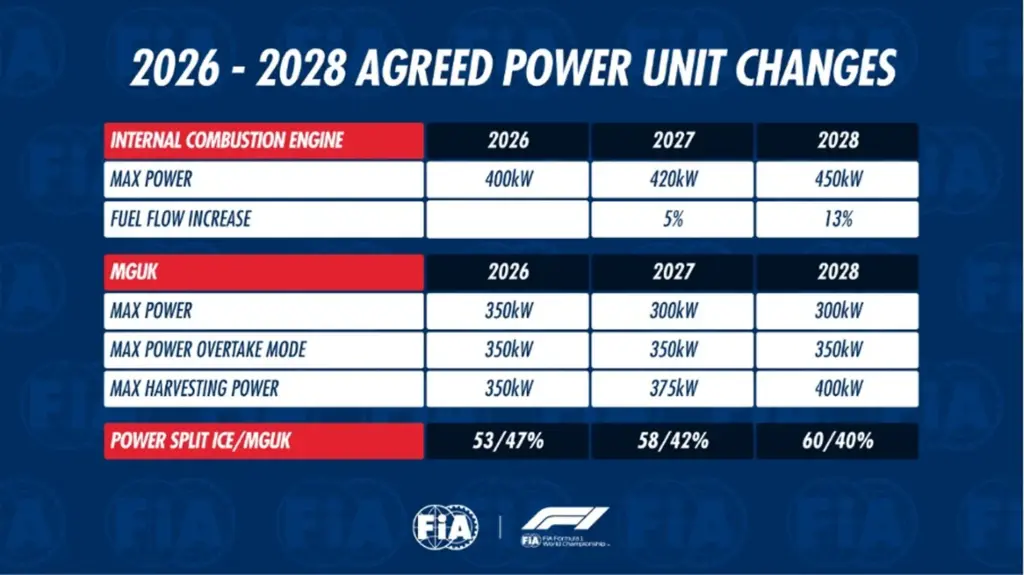
According to unofficial information, battery capacity will increase from the current 4MJ to 5 MJ from 2028. Under current regulations, a full battery allows driving at full electric power for 13-14 seconds until it is depleted. From 2028, this will be close to 20 seconds considering the larger battery capacity and the maximum power limitation. So realistically, electric energy should not run out (except in extreme cases on a few tracks), because there are very few sections on tracks where you drive at full throttle for that long. Besides, cars will reach maximum speed faster and electric energy will be cut off to prevent them from being too fast (similar to this year).
Update 26.06.2026 – Technical regulations for the 2027 season published
The FIA has published the technical regulations for the 2027 season, and they contain specifics regarding power units:
– Fuel flow increased by 5% from 3000 MJ/h in 2026 to 3150 MJ/h in 2027.
– Maximum ERS-K system power increases from 350 mW to 375 kW (this concerns recovery).
– In overtaking mode during sprints and races, maximum electric power is 350 kW.
– In qualifying sessions, sprints, and races (when not using overtaking mode), maximum electric power will be 300 kW.
Read more GP Great Britain 2026 with the highest attendance in F1 history
– Battery capacity increases from 4 MJ in 2026 to 4.5 MJ in 2027.
– The energy recovery capability during formation laps, reconnaissance laps, behind SC, and qualifying on out laps has been significantly increased to 10 MJ. This will ensure batteries are full at the start of important laps.
There is a negative effect of the approved changes
The negative side effect of the compromise solution will be the shortening of some race distances only in 2027. The reason is finances. Several teams want to use the same monocoques (the car’s skeleton, its most expensive element) in 2026 – 2027 and therefore cannot introduce larger fuel tanks. In 2027, fuel consumption will increase by 5%, i.e., by 3-4 kilograms over the race distance. Fuel consumption varies depending on the track, and each team designed the tank to be full on the most fuel-hungry tracks. Therefore, the FIA approved that the number of reconnaissance laps before the race will be limited at selected races. Additionally, the length of several races in the season will be shorter by one – at most two laps. Unfortunately, I do not have in my archives a division of tracks by fuel consumption, but certainly, the most fuel-hungry tracks include Bahrain and Singapore. At the opposite end is Mexico, where little fuel has always been needed.
Power units in 2028 will be real rockets
Little is said about this in the topic of approved changes, but if the FIA does not change anything in the next year and a half, in the 2028 season power units should have over 1100 horsepower maximum power, which will be available for a very long time. I will be a pessimist here, but it seems to me that currently they are not thinking about this and actions will be introduced then to limit maximum speeds on some tracks for safety reasons, as was done this year in Monaco. Let’s look at the presented numbers:
The FIA states in its calculations that this year combustion engines have 400 kW, i.e., about 540 horsepower. This is true, but for the weakest engines. The most powerful Red Bull and Mercedes engines, according to media reports, have about 430 kW, i.e., 585 horsepower. FIA assumes that combustion engines in 2028 will have 450 kW – the 50 kW increase will be caused by a larger fuel dose. FIA forgets about the natural development of combustion engines, which will continue. We can assume that the most powerful combustion engines will have about 480-500 kW in 2028, i.e., 650-680 horsepower. For comparison, combustion engines in 2025 had over 850 horsepower.
The maximum electric power in basic mode will be 300 kW, i.e., 408 horsepower, and in overtaking mode 350 kW, i.e., 475 horsepower. These values are strictly limited by regulations.
Based on these numbers, we see that the maximum power of a power unit using basic electric mode would be 1060 – 1090 horsepower, and in overtaking mode 1125 – 1155 horsepower. These are very large values, and this year’s cars already reach higher maximum speeds than in previous years, their acceleration is excellent. FIA will probably try to maintain downforce and drag at a similar level, so acceleration and maximum speeds will increase. I see no other way than cutting electric power at 355 km/h – as currently, but in 2028 this will matter less due to the increased importance of the combustion engine. FIA may decide to cut power at a lower speed.
Due to the higher engine power, lap times will improve, especially on tracks with many straights, and we can then expect records to be broken.
Summary and some conclusions
Engine manufacturers face a big challenge because they will have to rebuild their engines before the 2027 and 2028 seasons. We will see how much the FIA loosens development possibilities, but it is necessary, especially combustion engines will have to be significantly changed. There is already information from the German Auto Motor und Sport that Audi has started work on a completely new power unit for the 2028 season. This is related precisely to these regulatory changes.
The approved changes should solve practically all issues that drivers or fans dislike about current engines. It’s a pity it will only be in 2028. Changes for the 2027 season will significantly improve the situation, but there will still be a few tracks where power unit imperfections will appear. A stronger combustion engine will mean the car will be less dependent on electric power, so its lack after battery depletion will be less noticeable. Limiting maximum electric power will make it last longer, i.e., the car will have full power available a few seconds longer on each lap. Overall, this will improve car performance, lap times will be better. Ratios around 60/40 are, in my opinion, optimal for current power units – realistically it will probably be 62/38. If it were not for some manufacturers and the FIA being fixated on the marketing message of a 50/50 power split, regulations should have looked like this from 2026.
The FIA president is currently strongly pushing for the introduction of V8 engines in 2030 or 2031. In my opinion, the above regulatory changes will strongly hinder his plans. Engine manufacturers will be very busy modifying current engines over the next two years. They have spent hundreds of millions of euros preparing them, and now they have to keep investing heavily due to regulatory changes. The effects should positively impact F1. Will manufacturers want to give up these engines after only 4-5 seasons of use – I do not think there will be broad support for that. I remind you as always that manufacturers cannot work on two types of engines simultaneously (they have budget and dyno time limits). Development of current engines would have to be frozen so factories could focus on developing the new engine type. Before the introduction of engines in 2026, development of the previous ones was frozen for four seasons. Personally, I expect current engines to be used longer than currently planned. The topic of switching to V8 will be postponed.
Read more Maciej Gładysz with his first victory in Formula 3 and a big leap in the standings